

One Big Thing
H-1B immigration has long been proven to boost innovation, entrepreneurship, and America’s macroeconomic outcomes. New research from EIG’s Adam Ozimek and Sarah Eckhardt shows that it also provides a shot in the arm for America’s fiscal woes.
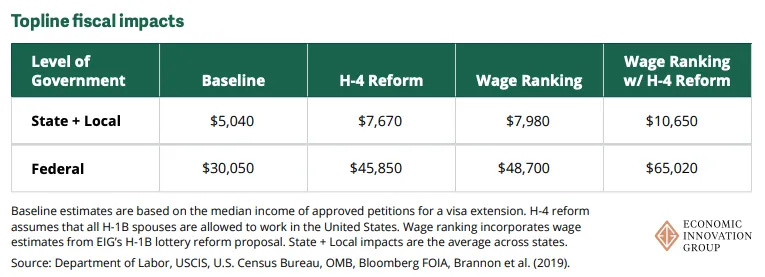
In a report we published on March 17, Adam and Sarah find that the average H-1B household contributes $30,050 net each year to the federal budget. That’s 2.6 times the $11,530 contribution of a typical U.S. household.
Adam and Sarah furthermore break down the fiscal benefits for all 50 states and the District of Columbia. In 49 states, H-1B households are net fiscal positives, contributing an average of $5,040. These benefits are evident even in low-income states like Mississippi and West Virginia, which draw net fiscal impacts from H-1B households of $4,600 and $5,780 respectively.
As EIG has argued previously, the H-1B program leaves much room for improvement. This report models the fiscal impact at the federal level and the state level of implementing two high-leverage reforms: authorizing H-1B holders’ spouses to work in the United States, and changing the H-1B selection process from a lottery to a wage-rank system. Combining our two reform proposals would more than double the positive fiscal impacts, to $65,020 at the federal level and $10,650 at the state level.
Check out the full report, a handy one-pager, and an accompanying Agglomerations post here.
Policy
Washington State became the fifth state to impose a full ban on noncompete contracts, which will take effect next year. The bill passed with bipartisan support and follows a 2020 reform that banned noncompetes for middle and low wage workers. EIG released a statement in response, quoting CEO John Lettieri: “Washington State’s action marks a significant step forward in restoring dynamism and opportunity in the labor market. Noncompete agreements prevent workers from taking better jobs, limit their earning potential, and impede the formation of new businesses. By moving to curb their use, Washington is helping to unlock opportunities for workers while strengthening competition and innovation across its economy.”
Following the launch of the new EIG housing vertical in February, we are delighted to announce the members of our new Housing Advisory Council:
Scott J. Alter, Co-Founder and Principal, Standard Communities
Alex Armlovich, Housing Program Officer, Coefficient Giving
Alfonso Costa, Jr, COO, Falcone Group
Arpit Gupta, Associate Professor, NYU Stern
Bobby Fijan, Co-Founder, Building Housing for American Families
Colin Higgins, Executive Director, National Housing Crisis Task Force
Edward Glaeser, Professor of Economics, Harvard University
Emily Hamilton, Senior Research Fellow, Mercatus Center, GMU
John Zeanah, Chief of Development and Infrastructure, City of Memphis
Michael Novogradac, Managing Partner, Novogradac & Company LLP
Mike Kingsella, CEO, Up for Growth
Paul Williams, Founder and Executive Director, Center for Public Enterprise
Sean Rust, VP of Development, NexMetro Communities
Stephanie Kestelman, Director of Housing, Arnold Ventures
Research & Analysis
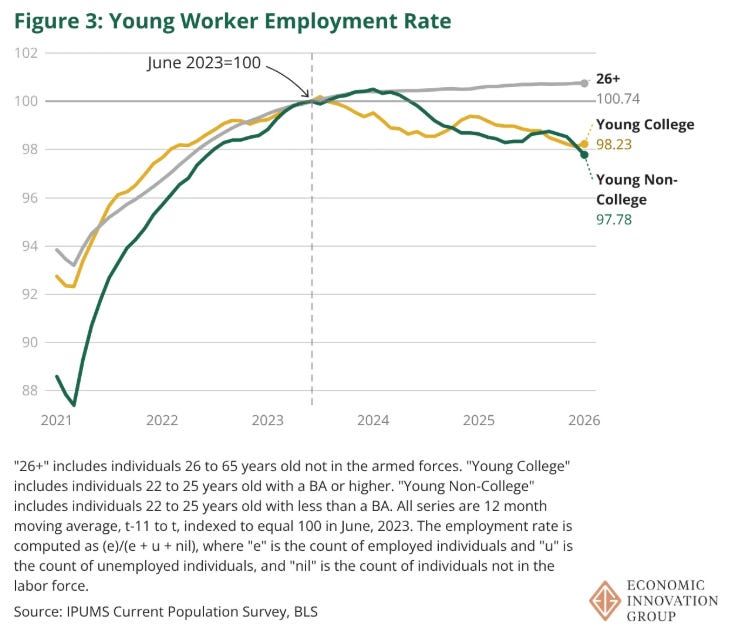
AI and Young-adult Jobs: The Real Mystery
To understand what’s happening in the labor market for young adults, it’s necessary to look at the employment rate for college and non-college workers. Both are lagging behind the employment rate for adults older than 25. Something mysterious is happening, but as Adam Ozimek and Nathan Goldschlag write, this does not seem like a story about AI displacing entry-level college graduates.
Place and Male Educational Attainment Gaps
There is significant educational attainment variability between men and women within the nation’s most distressed counties, writes Sarah Eckhardt. She investigates plausible reasons and finds: “We can see that on average, counties that have large black populations, are located in the south, are rural, or were a manufacturing hub in the ‘90s, have a more negative gap [female minus male high school education rates] than those that are not. Those that have a higher-education institution located in the county, or where a large share of households with children are run by a single parent, have a more positive gap.”
How the Housing Market Split in Two
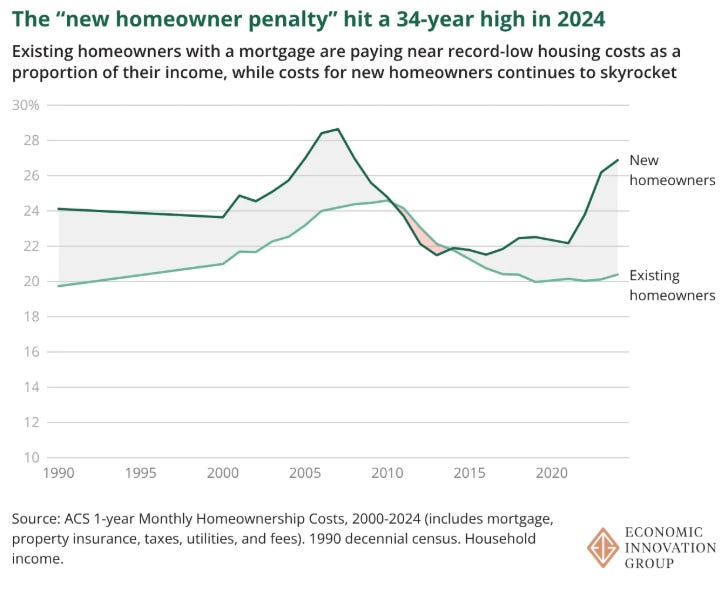
“New homeowners are now burdened with some of the highest housing costs in decades,” writes Jess Remington, “while existing homeowners — those who have owned their homes for longer than a year — are actually spending less on housing than in the past.” The new homeowner penalty, which refers to housing costs for new homeowners above those paid by existing homeowners, hit a 34-year high in 2024. Just as worrying is that too many of the housing policies favored by policymakers would widen the gap even further.
Does a legacy in manufacturing preclude a future in it?
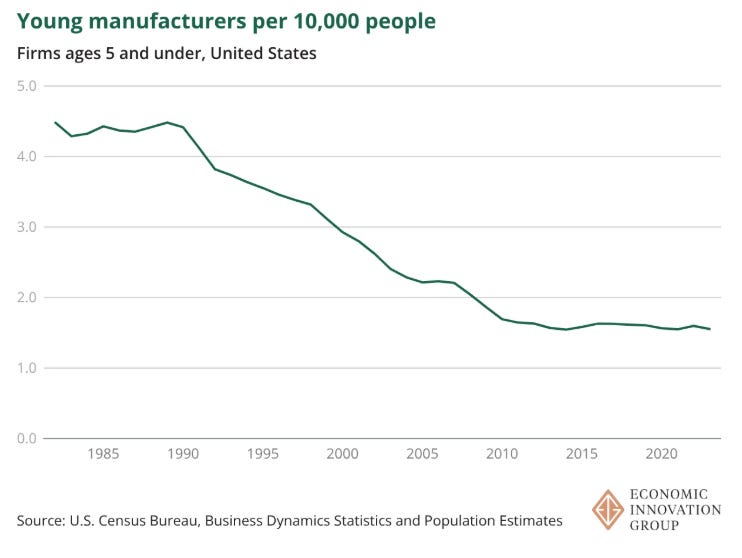
Kenan Fikri looks at the economic geography of manufacturing activity across the country and finds that new manufacturing is now “avoiding hubs of established prowess and instead gravitating towards places with little history in manufacturing. This tendency is not new. A fact of modern U.S. manufacturing appears to be that it trends towards deagglomeration.” Among other discoveries, Kenan also finds that the United States “has only 1.5 young manufacturing firms per 10,000 people today — a figure that has been bumping along at all-time lows for 15 years and counting.”
The New Bazaar
The Roots of our Zero-Sum Moment
Stefanie Stantcheva is an economist at Harvard and the head of the Social Economics Lab, where her team has done extraordinary work investigating how people form their opinions about economic and political topics. She speaks with Cardiff Garcia about the findings in her paper (with co-authors Sahil Chinoy, Nathan Nunn, and Sandra Sequeira), “Zero-Sum Thinking and the Roots of US Political Differences,” which was just published in the American Economic Review.
Stefanie and Cardiff discuss:
Zero-sum similarities and differences between Democrats and Republicans
The economic geography of zero-sum thought
The finding that surprised her the most
The generational gap in zero-sum thinking between young and old
The policy implications of her research
A preview of her upcoming work on zero-sum thinking and AI
Ideas for a Post-YIMBY Housing Future
Arpit Gupta, a finance professor at NYU, speaks with Cardiff about his latest contributions to the study of housing affordability, remote work, artificial intelligence, and finance. Arpit has offered a variety of reform proposals that both complement YIMBY ideas and also prepare for a future after a YIMBY victory. Among them are re-thinking property taxes, accelerating depreciation schedules, and making it easier for factory housing to get to market.
Around the Horn
Using the story of the player piano, Adam Ozimek writes in The Atlantic on the durable demand for bespoke, human labor even as technological change would appear to make it obsolete.
Emily Peck in Axios cites Jess Remington’s Agglomerations post on the housing market’s splitting in two.
Eric Levitz in Vox cites EIG’s recent publication from Google economists Zanna Iscenko and Fabien Curto Millet on how to interpret LLMs’ impact on the economy.
In the Washington Post, columnist George Will cites Sarah Eckhardt, Ben Glasner, and Connor O’Brien’s geographic analysis of recent electoral politics.
Also in the Washington Post, Kevin Schaul and Shira Ovide cite EIG’s research as a counterweight to the runaway narrative that AI is harming the labor market for young college grads.
And Jordan McGillis makes that same case in National Review, arguing that college grads are markedly better off than their non-college peers.
The Seattle Times cites EIG’s work on noncompetes as the state of Washington prepares a noncompete ban.
EIG Chart of the Month
Via Jess Remington’s post on how the housing market split in two:
EIG Video of the Month
Ben Glasner riffs on the work of Stefanie Stantcheva, as discussed recently on The New Bazaar. See more EIG videos here.