



The unemployment rate for recent college graduates has moved up substantially over the past two years — more than either overall unemployment or unemployment for young workers without degrees. It is therefore easy to understand why so many people have begun wondering if AI is to blame.

Are they right? Has AI started automating away the entry-level knowledge work of skilled workers?
Digging deeper
The biggest weakness of this story is its exclusive focus on the unemployment rate.
The unemployment rate only counts someone as unemployed if they are actually looking for work. The problem with this becomes obvious when glancing at the labor force participation rate, which shows how many people are either working or looking for work — the labor force includes both — as a share of the total given population.
Over the last year, non-college young adults aged 22–25 have disproportionately given up looking for work. These discouraged workers won’t count as unemployed, which means that the unemployment rate is lower than if it did count them, a misleading sign of labor market health. Young college-educated workers, on the other hand, are now participating in the labor force at about the same rate as they were in the middle of 2023.
And young people in general are lagging behind the rising participation rate among all workers — perhaps suggesting a common cause behind the labor market struggles of both college and non-college young adults alike rather than something that only damages the prospects for college grads.
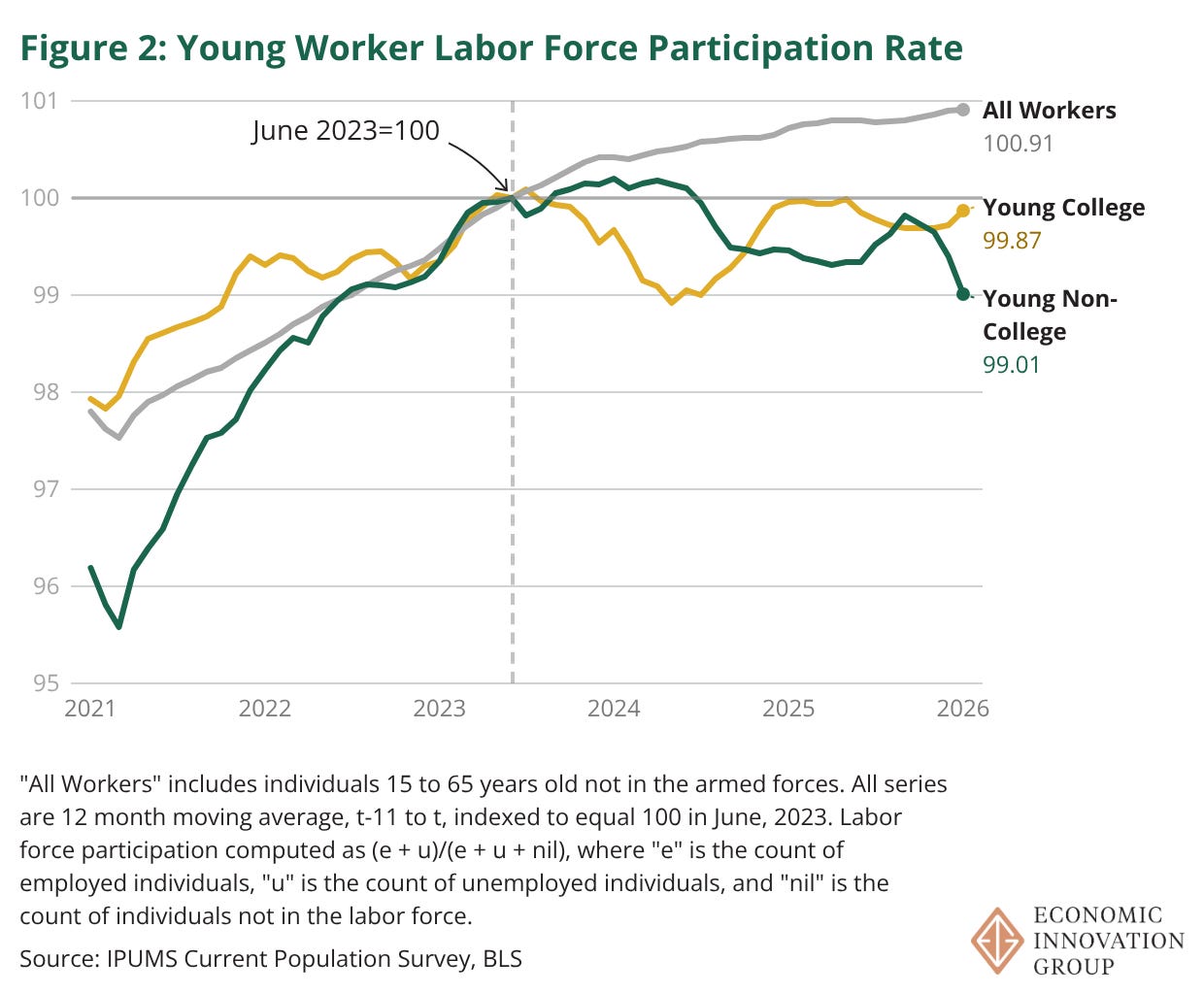
The labor force participation rate is itself imperfect, however. It does not change when workers lose their jobs and become unemployed, as unemployed workers are still part of the labor force. Though a useful complement to the unemployment rate, any indicator that fails to capture workers going from employed to unemployed is clearly insufficient for understanding labor market health.
The right analysis
For a more apples-to-apples comparison — one that avoids these data issues and best shows how the labor market outcomes of young college graduates compare to those of young people without degrees — the right measure is the share of all 22- to 25-year-olds (working, searching for work, or out of the labor force) who are working. This measure is known simply as the employment rate.
It has at least a couple of key advantages. Unlike the unemployment rate, the employment rate does not show a deceiving improvement if workers become discouraged and stop looking for work. And unlike the labor force participation rate, it successfully captures workers moving from employed to unemployed.
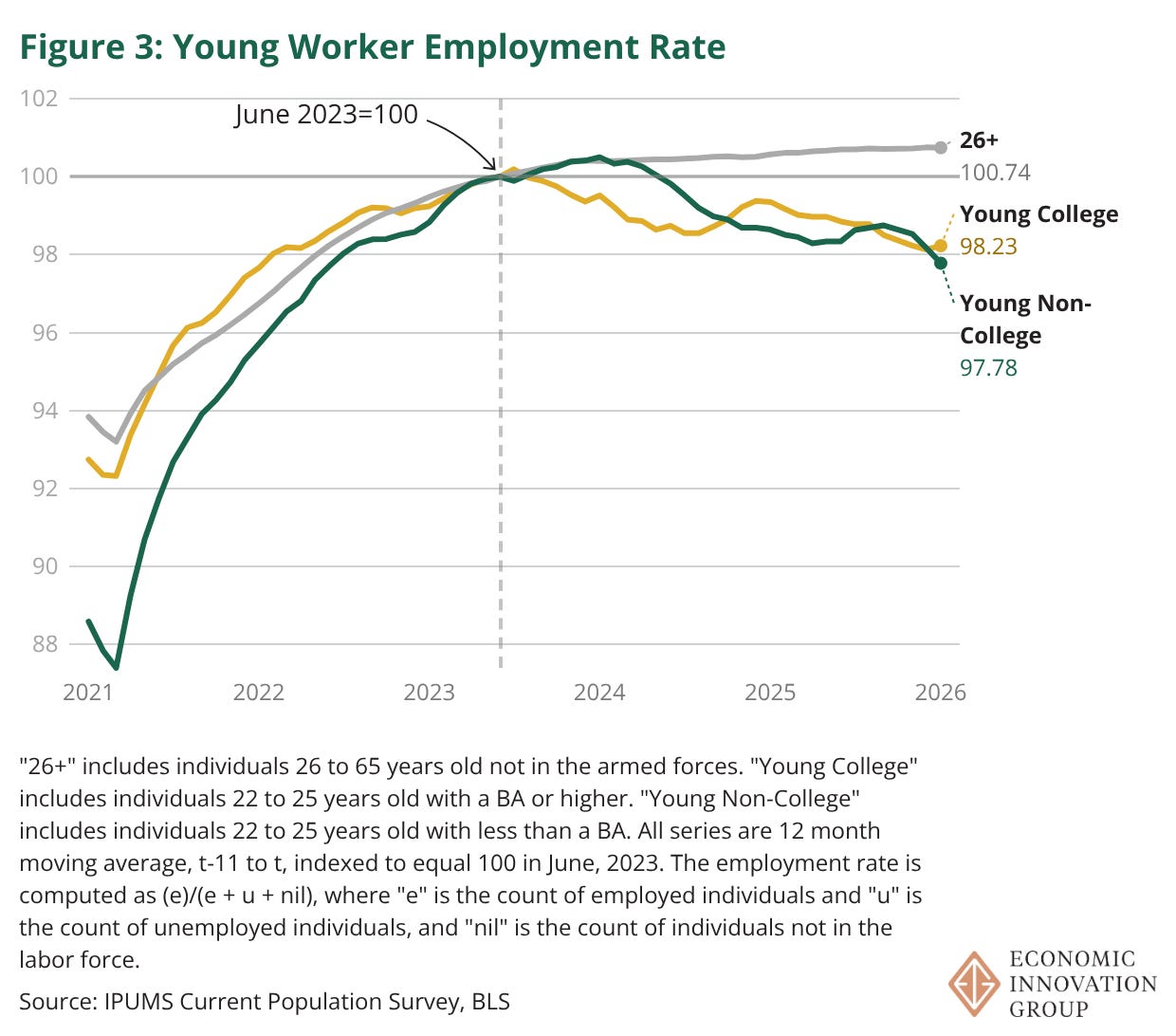
It turns out that employment rates have declined for young adults both with and without degrees. If anything, those without degrees have actually endured marginally worse labor market outcomes. And similar to the trend observed in labor force participation, growth in the employment rates of young adults of all education levels have lagged behind those of all other workers.
More Joes and Janes College?
There is one other lingering measurement issue to address. Many young individuals who are not working are doing so because they are in college. While labor market conditions can affect the decision of whether to attend college, going to college is not the same thing as unsuccessfully seeking employment. If, for example, a rising share of non-college young adults are not working specifically because more of them have chosen to go to college, then their depressed employment rate might be taken as an inaccurate signal of problems in the labor market. All of which suggests a useful tweak to the employment rate — excluding those attending school to see if recent enrollment rates have changed enough to affect employment trends. We have done so in Figure 4:
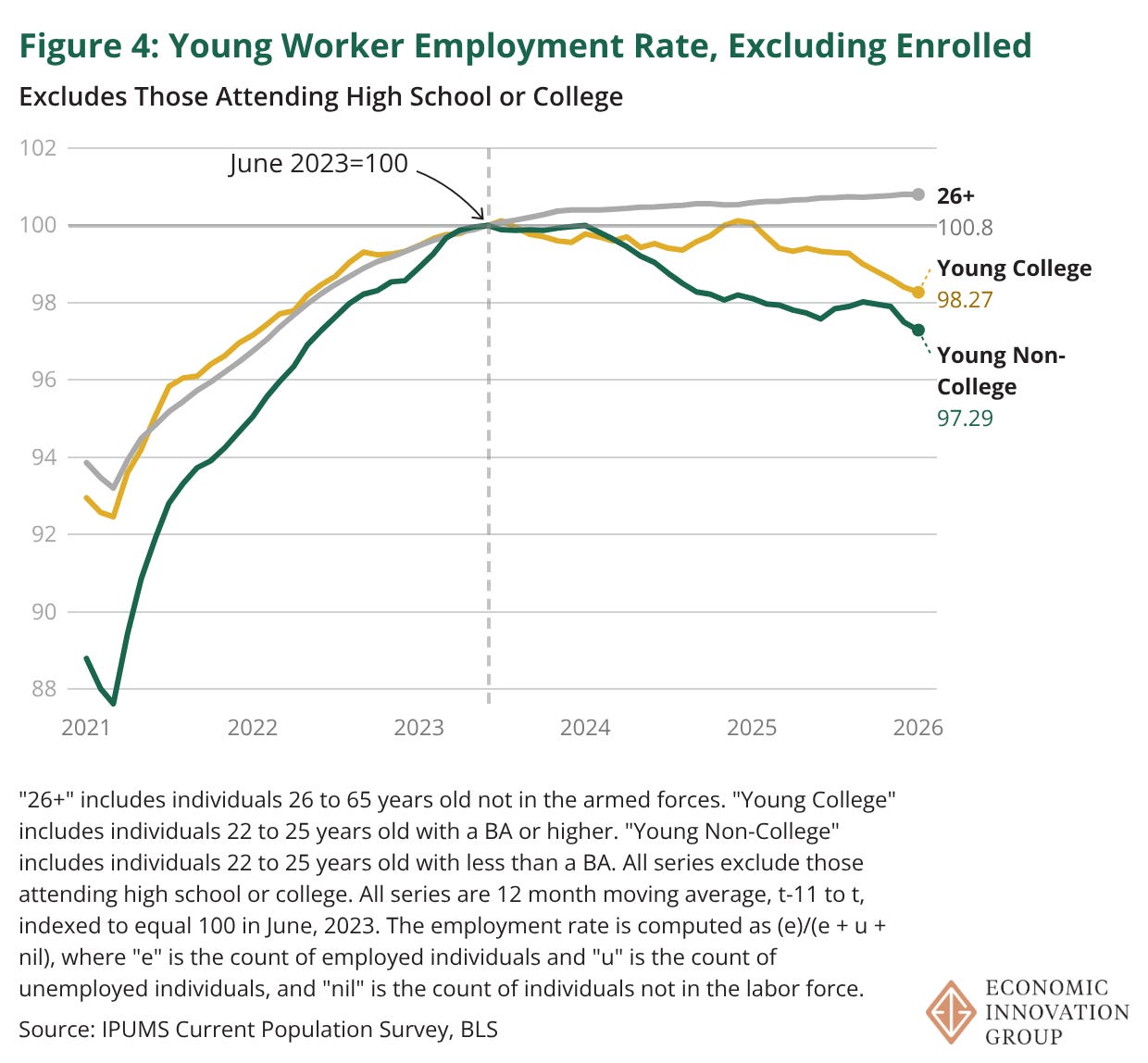
As should be clear from viewing Figure 4, the trends are nearly the same. In fact, when excluding those in school, outcomes for non-college youth are actually a bit worse relative to college graduates than when including young adults in the measure.
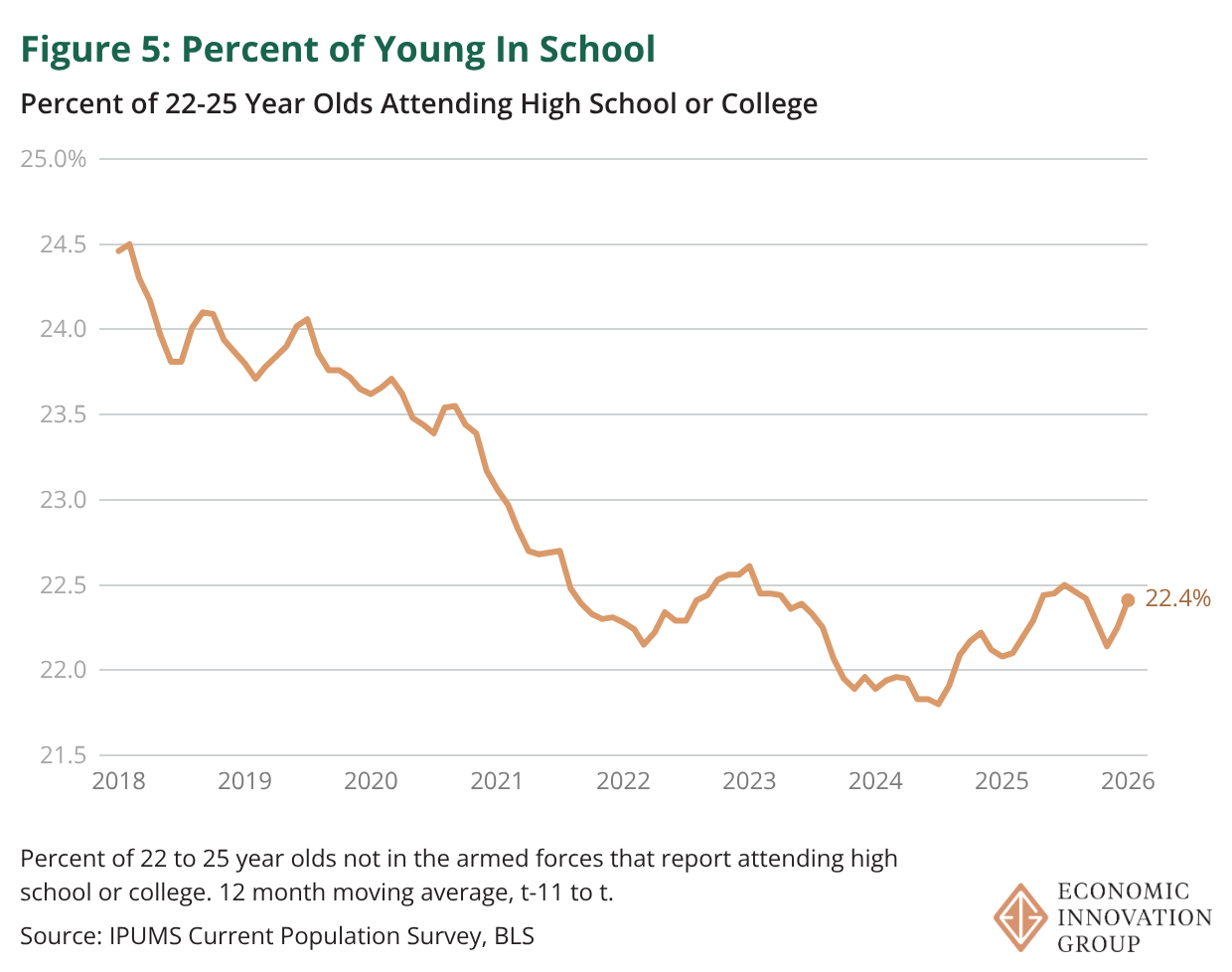
The absence of a big effect from taking college students out of the calculation is not surprising, as college enrollment rates for this age group are about where they were three years ago, with only small fluctuations since:
Identifying the real mystery
A growing body of complex econometric studies is now examining the impact of AI on the labor market.1 This work is valuable and essential. But before we begin searching for explanations, we first need an accurate understanding of the patterns being explained. Young workers of all education levels are lagging the rest of the labor market. Focusing too much on education rather than age as the main labor market weakness starts us in the wrong direction.
So is AI nonetheless to blame for the broad-based weakness in the labor market for young people? It’s true that some lower-skilled jobs can be replaced by AI. Call center workers and data entry jobs are potential examples. But there are not enough of these jobs to really drive the youth labor market. And this explanation certainly does not fit the media narrative focused on AI displacing computer science majors and entry level college graduates.
Just what exactly is causing young workers to be left behind is a genuine economic mystery. But to solve a mystery, we must first accurately identify it. The whodunnit is not about recent college graduates, but about young people of all types.
View the Github with code for replicating this analysis here.
Call center workers, covered by Census Occupation code (OCC) 5240 Customer service representatives, account for 2.7 percent of employed young workers (ages 22–25) between 2018 and 2021. Data entry workers, or OCC 5810 Data entry keyers, account for 0.2 percent of young workers in that period.
Isn't it likely that when AI displaces a young college-educated worker from a job, she then seeks out and obtains a job that would typically be performed by someone without a college degree, thereby displacing them? The premise that AI would disproportionately affect recent college grads ignores the fact that they can just trade down while non-college-educated workers can't trade up.
Couldn't it just be that many of these entry-level jobs are being outsourced?