


One Big Thing
On the final day of April, President Trump signed an executive order to address one of the biggest wealth-building gaps in America’s economy: that too many workers, including 42 percent of full-time private-sector workers, lack access to retirement plans.
With the finalization of a policy hinted at in February’s State of the Union address, the Trump administration has created a new path to retirement for these workers.
As we explain in our detailed Q&A about the new policy, the government is creating the infrastructure and parameters for financial institutions to offer workers a retirement product similar to the Thrift Savings Plan (TSP), which is the retirement vehicle currently available to federal employees and members of the military. Moreover, these new individual retirement accounts will offer a federally-supported $1,000 annual match to low-income workers, consistent with the Saver’s Match legislation passed by Congress in 2022.
These new products will be listed on TrumpIRA.gov, along with an explanation for how eligible workers can claim the Saver’s Match. The new web site will be launched by the Treasury Department by January 1st, 2027, according to the executive order.
This policy builds upon years of EIG research, led by senior economist Ben Glasner. As Glasner wrote in 2023, “Retirement accounts are the largest source of aggregate fungible wealth for American households and are an important tool to build a nest egg for the future. Unfortunately, access to employer-provided retirement plans remains deeply divided across earning levels and regions of the country.”
With the launch of this new policy, EIG research estimates that 54 million more workers will now have access to a retirement plan. Of those 54 million, 11.5 million will be eligible for the full Saver’s Match, with another 14.6 million eligible for a partial Saver’s Match.
The new retirement initiative is a clear victory for economic inclusion, and it also creates momentum for even more progress. The next step is for Congress to pass the Retirement Savings for Americans Act (RSAA), a bipartisan piece of legislation that was built on the recommendations of a 2021 EIG white paper co-authored by economist Teresa Ghilarducci and Kevin Hassett, the current Director of the National Economic Council. The RSAA, most recently reintroduced by Representatives Lloyd Smucker and Terri Sewell and Senators John Hickenlooper and Thom Tillis in April of 2025, would automate enrollment, set a default contribution rate, and increase the match.
For media coverage of the new Trump administration retirement plan announcement citing EIG’s research and work behind the scenes, check out Axios, Semafor, CNBC, Barron’s, and USA Today.
Policy
The EIG Opportunity Zones Coalition sent a letter to congressional leaders urging them to remove a provision in the Senate’s 21st Century ROAD to Housing Act that would restrict built-to-rent (BTR) development by requiring investors to sell properties within seven years. The coalition warns this would effectively eliminate Opportunity Zone investment in BTR housing, since OZ investments must be held for 10 years to receive the full tax benefits. The provision could potentially reduce new home construction by an estimated 72,000 units annually.
Research & Analysis
Manufacturing job gains are fading, but growth persists in dynamic places
The post-pandemic recovery of manufacturing jobs has been strikingly uneven across states and metropolitan areas. “Over four-fifths of this employment growth has occurred in just 354 out of 3,143 counties,” writes Jason He in his detailed analysis of the manufacturing sector. The two states that really stand out are Florida, because of its high manufacturing dynamism (elevated startup and exit rates), and Texas, which added the most manufacturing jobs of any state and accounted for over a third of the country’s manufacturing employment growth since 2019, writes He. National manufacturing employment has slipped since hitting a post-pandemic high in the third quarter of 2023.
H-1B Workers are Critical for AI Dominance
H-1B workers now represent an estimated 4.3 percent of the nation’s total AI workforce, and each year the share of H-1B visa holders who work in AI keeps climbing. Furthermore, write Sarah Eckhardt and Jason He, “Nearly four out of five new H-1B holders working in AI also completed their education in American universities, compared to 52 percent of H-1Bs overall. Losing many of these workers to China would undermine the domestic AI industry and could threaten American national security.” The United States should embrace
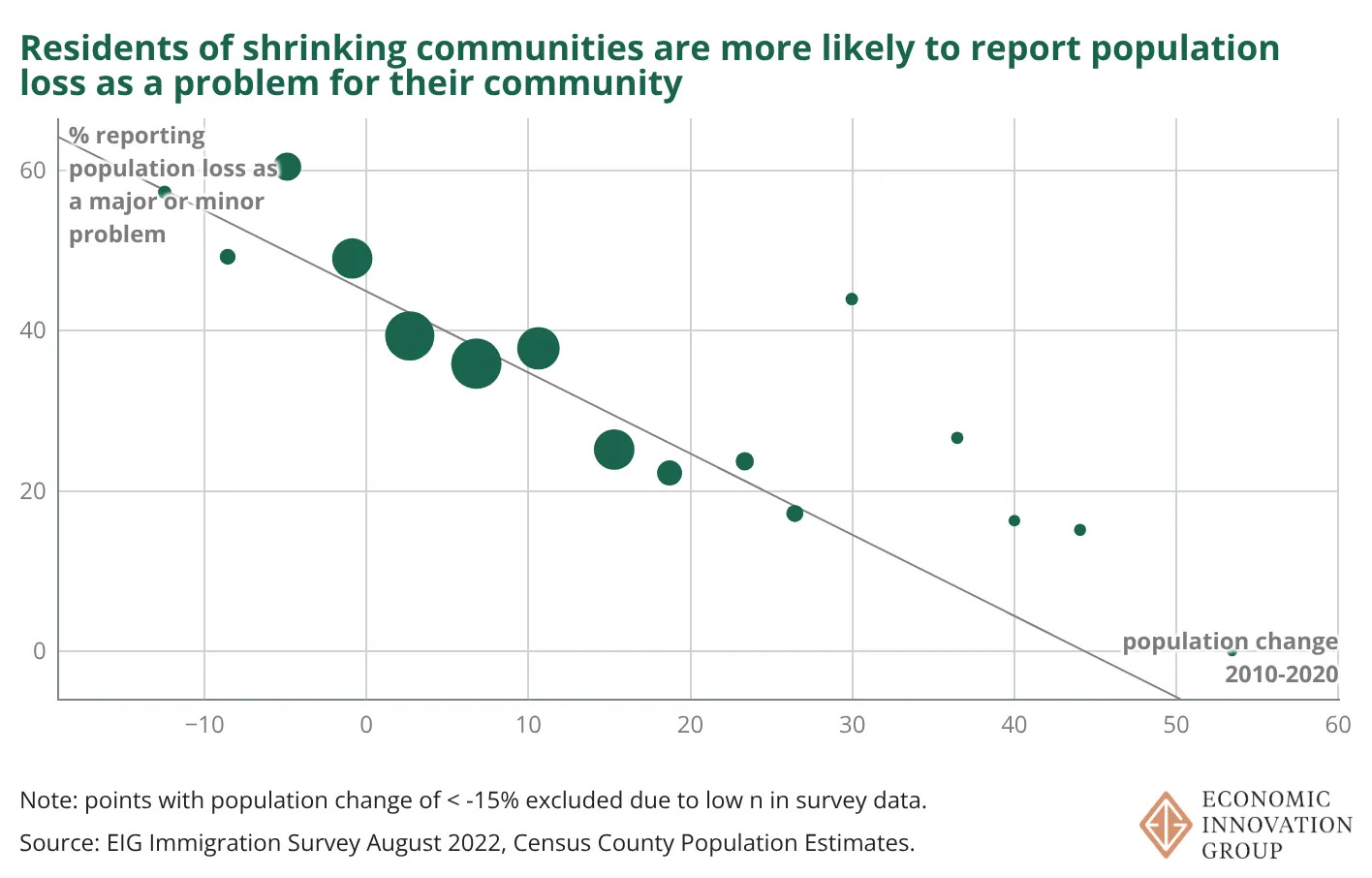
The Problem of Population Loss
Do residents of stagnant local communities recognize population loss as a problem? Sarah Eckhardt and Adam Ozimek answer: “The data show that local perceptions match demographic reality. Eighteen percent of respondents living in counties that lost population between 2010 and 2020 identified population loss as being a major problem for their community, versus 10 percent of those living in growing places. Including those who see it as a minor problem, 54 percent of respondents in declining counties view population loss as an issue, versus 34 percent in growing counties.” In addition to their direct contributions to the AI sector, these workers generate substantial fiscal benefits for the government. The United States should reform its high-skilled immigration system to make it easier for these workers to come, work, and stay here.
Around the Horn
At the Center for Economic Policy Research, Nathan Goldschlag and coauthors explain why universities are losing top AI researchers to the private sector.
In the Wall Street Journal, Jordan McGillis argues that female labor force attachment is a key driver of household income dispersion.
In the New York Times, Jessica Grose cites Adam Ozimek and Nathan Goldschlag’s Agglomerations analysis on what’s happening in the young-adult job market. Rogé Karma cites the same analysis in The Atlantic.
In Business Insider, James Rodriguez features Jess Remington’s research on the bifurcation of the housing market.
In Newsweek, Billal Rahman quotes Sam Peak on the effects of the Trump administration’s $100,000 H-1B fee.
In the Minnesota Star Tribune, Emma Nelson draws upon EIG’s Great Transfer-mation to show the rising share of Americans’ incomes deriving from federal social programs.
EIG Chart of the Month
From the post by Sarah Eckhardt and Adam Ozimek showing that residents of stagnant communities recognize population loss and a problem for them.
EIG Video of the Month
Jason Harrison and Ben Glasner riff on Jess Remington’s post in March, How the Housing Market Split in Two, which showed the differing experiences between new and existing homeowners: