

One Big Thing
A dynamic economy needs a dynamic housing market. America doesn’t have one. This month EIG launched a new housing policy vertical to help rectify that.
Housing costs are pricing families out of opportunity-rich regions, distorting labor markets, and weakening national growth. EIG argues that affordability requires large-scale supply expansion across all housing types, not just targeted “affordable housing” programs. While zoning barriers are local, federal policy can reshape incentives at scale. The initiative launches with a proposal for Right to Build Zones, a federal framework designed to increase housing production by aligning market forces with local reform rather than micromanaging outcomes.
Follow our new housing work here.
One More Big Thing (February was a Big Month)
In his State of the Union address, President Trump announced a plan to offer retirement accounts to American workers who lack access to them via their employer. The retirement accounts are modeled on the Thrift Savings Plan, which is the retirement vehicle available to federal employees.
As EIG explained in response to the speech, the president’s announcement highlights the bipartisan recognition that too many Americans are left behind by the retirement system. Solving this problem has been a central focus of EIG’s work:
Just how big is the problem? Our research has consistently shown the scale of the access gap.
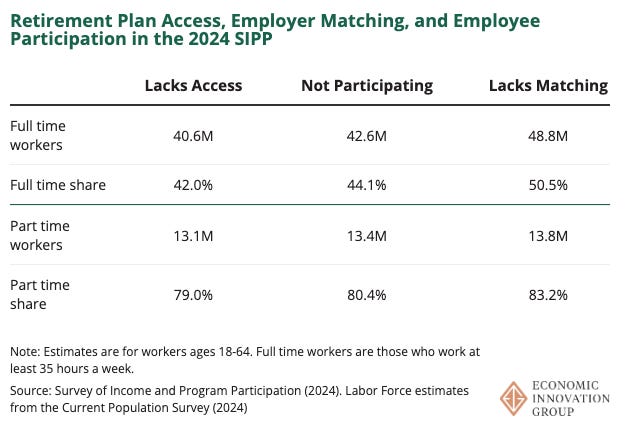
42 percent of full-time working Americans do not have access to retirement plans
50.5 percent do not receive an employer match
Lower-income workers are disproportionately left out of the current system. A staggering 78.7 percent of full-time workers in the lowest-earning decile (earning less than $27,400 a year) lack access to a retirement plan.
Establishing accounts for low-income workers is only the first step. The administration has also indicated a desire to work with Congress to automatically enroll eligible workers and expand the pool of eligibility for matching benefits. The bipartisan Retirement Savings for Americans Act (RSAA) — which incorporates an array of EIG’s policy recommendations — offers just such a framework.
Policy
Adam Ozimek, Jess Remington, and Tina Lee introduced their concept paper for Right to Build Zones, an idea first proposed by EIG in October 2024. “A tangle of regulations has made it impossible to build enough housing in America, a problem that has been worsening for decades,” they write. “The result is a nationwide shortage of millions of homes, rising housing costs, and growing pressure on federal policymakers to address an affordability crisis that is largely driven by rules set at the local level. Right to Build Zones (RBZs) is a new proposal designed to help municipalities unlock housing supply while preserving local control.”
With Opportunity Zones having become permanent last year as part of the One Big Beautiful Bill Act, Catherine Lyons has published for Novogradac a handy guide for governors and mayors on how to proceed next. Governors are responsible for nominating 25 percent of their state’s eligible census tracts for OZ 2.0 designation. EIG’s guide “provides a clear roadmap for navigating the OZ selection process, creating a map that sets communities up for a decade of investment and impact once new designations come into effect Jan. 1, 2027.” You can also read the comprehensive version of the guide here.
Research & Analysis
The Impact of Opportunity Zones on Housing Supply
Benjamin Glasner, Adam Ozimek, and John Lettieri have updated the findings of their working paper on the effects of Opportunity Zones on housing supply. From their summary: “By making novel use of HUD data sourced from U.S. Postal Service address counts, the study finds that the OZ incentive increased new housing construction by 70 percent in these areas, generating more than 416,000 new residential addresses between 2019 and the first quarter of 2025. The authors also find that the new development and investment did not merely shift from nearby neighborhoods: For every 100 new residential addresses caused by the OZ incentive, roughly 97 represents net new supply that would not have been built in the absence of OZs.”
The Flawed Paper Behind Trump’s $100,000 H-1B Fee
A recent paper by economist George Borjas attempted to compare the earnings of H-1B workers against those of native-born American workers. But as Jiaxin He and Adam Ozimek explain in their comprehensive critique, the Borjas paper “not only reached flawed conclusions but also influenced the Trump administration’s recent $100,000 H-1B fee policy.”
AI and the Economics of the Human Touch
“There are many jobs and tasks that easily could have been automated by now — the technology to automate them has long existed — and yet we humans continue to do them,” writes Adam Ozimek. Think of piano players, servers, actors, and so many more jobs that in part or in whole could have been lost to new technologies. The reason these jobs still exist is because of the perpetual demand for these jobs to offer a human touch. What are the lessons for the future effects of AI?
AI and the Real Bottlenecks to Growth
Some economists argue that ideas have become harder to find, a problem that AI can solve and thereby unleash a new era of rapid productivity growth. But what if the barriers to this golden epoch aren’t new ideas, write Nathan Goldschlag and Adam Ozimek, but rather a broad suite of societal obstacles that make these ideas harder to translate into economic growth?
Yes, high-skilled workers should have to compete
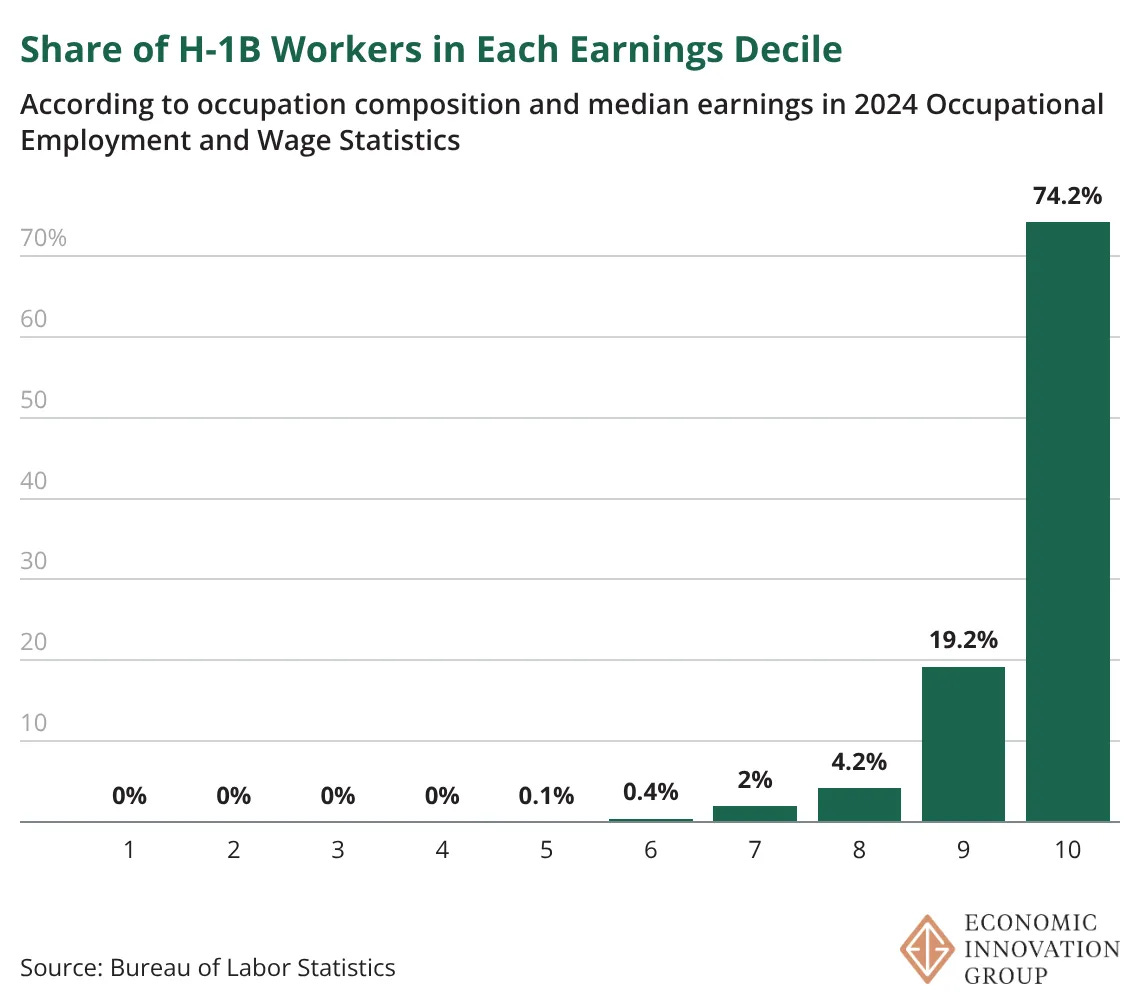
Populists are fond of protectionist ideas, including policies that insulate highly paid workers from having to compete against high-skilled immigrants. This is a mistake, writes Adam Ozimek: “To achieve the bipartisan goal of improving the labor market for the working class, vigorous competition among the top earners is important and even necessary. Not only would the rest of the country benefit — from more innovation, more entrepreneurship, and faster economic growth — but in the long run even the skilled American-born workers exposed to fiercer competitive pressures will fare better too.”
The New Bazaar
Cardiff Garcia and Adam Ozimek discuss Adam’s piece on AI and the economics of the human touch (see above). Plus:
The job that inspired Adam’s post
Why the Olive Garden represents a hopeful future for work in an age of AI
The perils and promise of AI for caregiving jobs
How Adam himself prepares for the eventual automation of his daily tasks
Listen to the episode or read the full transcript here.
Around the Horn
More outlets than we can count cited EIG’s work on retirement in response to President Trump’s announcement that the government would offer retirement accounts modeled after the federal Thrift Savings Plan (TSP). A small sampling: Washington Post, Wall Street Journal, CBS News, Reuters, Axios.
Jordan McGillis writes in the Wall Street Journal that the real reason the middle class feels poor is the widening gap between the median worker and the 80th percentile worker.
Ross Douthat of the New York Times cites Adam Ozimek’s post on AI and the human touch in his assessment of AI’s potential effects on the labor market.
EIG Chart of the Month
Via Adam Ozimek’s post on why high-skilled workers should have to compete:
EIG Video of the Month
Presented by Ben Glasner, a companion video to our 2025 Charts of the Year. See our YouTube and Instagram pages for more.