

The tax-advantaged retirement savings system in the United States is one of the most effective wealth-building programs in the world — but only for those who have access to it and have the right incentives to participate in it.
How many workers are left out of it?
How many workers do have access to retirement plans but decline to contribute to them? And why?
Data from the 2025 Survey of Income and Program Participation (SIPP) was just released, so we have newly-updated answers to these and many other questions.1
The headline numbers
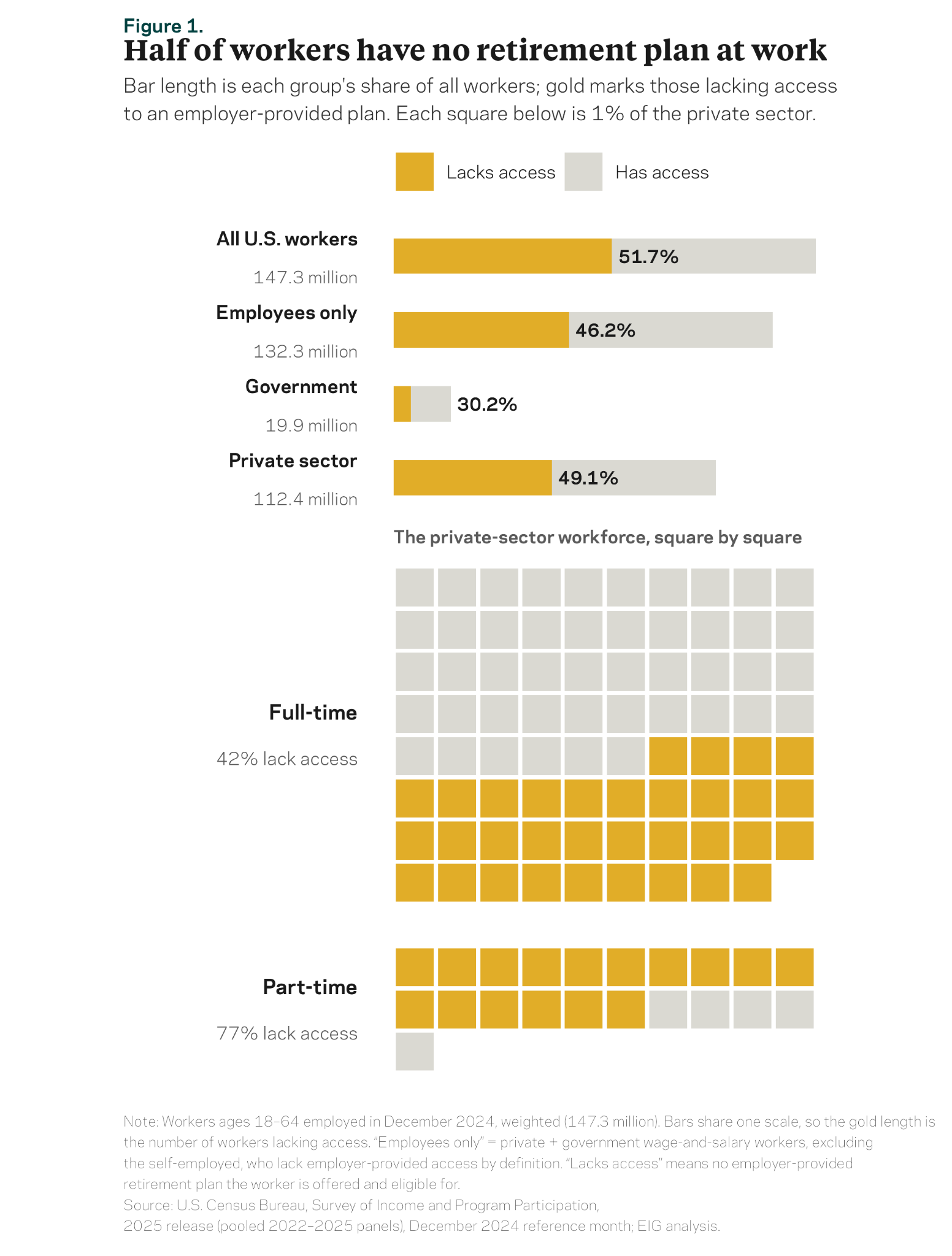
About 76 million workers — nearly 52 percent of working Americans ages 18 to 64 — lack access to an employer-provided retirement plan. But not every worker works for an employer, so we should probably cut out the self-employed from that total.
Excluding people who are self-employed and focusing only on the 132 million Americans ages 18 to 64 who work for an employer, about 46 percent of them, or 61 million, lack access to an employer-provided plan.2
Figure 1 further breaks down the access numbers, showing that workers in the private sector, which employs the majority of workers, are less likely to have access than government workers, and part-time workers are less likely to have access than full-time workers.3
Who gets a match?
A wide range of retirement plan types exist across the world of work. Only 37 percent of all workers receive an employer contribution or match. For those workers who do, the median amount received is about $3,000 per year. (The mean is about $5,800.)
Gaps by race, ethnicity, and education
While 82 percent of workers with less than a high school diploma and 64 percent of workers with a high school diploma lack access to a plan, only 31 percent of employees with a bachelor’s degree lack access.
Figure 2 offers details on retirement plans by race and ethnicity. The access gap is biggest for Hispanic and Black non-Hispanic workers, and smallest for Asian workers.

Income, access, and employer contributions
As would be expected, access to tax-advantaged retirement savings also differs starkly by household income, reflecting enormous differences between the highest and lowest earners.

In the lowest earnings decile, about 88 percent of private-sector employees lack access to an employer-provided retirement plan. Among the top decile of earners, only 14 percent lack access.
It is not just that access is better for high earners. At high income levels, meaningful portions of the workforce participate even if they do not receive an employer contribution to compound the benefits of savings.
Among workers who receive no employer contribution, those in the top half of the earnings distribution are about five times more likely to participate in an employer-provided retirement plan than those in the bottom half (19.9 percent versus 3.9 percent).

Higher-earning workers have greater likelihood of access to these plans, lower barriers to saving, and can more easily access the main federal tax benefit associated with retirement saving: deferring one’s income tax bill for retirement contributions until old age, when they will likely be in a lower tax bracket.
Another way to understand the same data: Expanding access to retirement plans for workers at the bottom of the income distribution is a necessary first step in addressing the future of retirement, but access alone will have a limited impact if it is not paired with a match or additional contribution.
What the tax code pays for
Both businesses and workers make their own decisions about how they spend and how they save, so the gaps that result may appear to simply reflect a range of preferences.
But the government is not neutral in how it influences those decisions. The tax code does not treat retirement savings as a cash-equivalent source of compensation; it incentivizes retirement savings.
In effect, taxpayers subsidize the retirement savings of high earners through foregone collection of tax revenue. My colleagues and I estimate that tax-advantaged retirement savings through income and payroll taxes cost between $256 billion and $356 billion in forgone annual federal revenue, measured on a present-value basis for savings made in 2024.4
When foregone tax revenue is understood as spending, subsidized retirement savings ranks among the largest expenditures in the federal budget.

That spending flows predominantly to retirement accounts that roughly half of workers cannot access via an employer-provided plan. The 48 percent of workers who are fortunate to have an employer-provided retirement account capture 97.5 percent of the tax benefit.
The Saver’s Match
Beginning in 2027, the Saver’s Match will replace the nonrefundable Saver’s Credit with a refundable government match of up to $1,000 (half of the first $2,000 a worker contributes) to be deposited directly into a retirement account, and phased out by income and filing status.
About 30 million workers (20.1 percent) are income-eligible for a Saver’s Match. But roughly 21 million of them lack a qualifying account — a 401(k)-type account or IRA — to facilitate the receipt of the Saver’s Match.
This puts the Saver’s Match, as currently designed, in a difficult place. The wedge between eligibility and access is not something the Saver’s Match is currently built to solve.

In April 2026, a White House executive order established TrumpIRA.gov, with the aim of connecting workers without an employer plan to low-cost individual retirement accounts eligible for the Saver’s Match.5 While these plans will not be able to automatically enroll individuals, it is possible that TrumpIRA.gov will meaningfully help workers to access the much-needed, user-friendly retirement savings vehicles that can also facilitate access to the Saver’s Match.
So what are the facts?
America’s tax-advantaged retirement savings system is a powerful wealth-builder, but it is not one that all workers have access to. If we can find ways to close the access gap, we can help tens of millions of workers reach a dignified retirement as a just reward for years of work. How many could be helped?
Right now, 55 million private-sector employees — nearly half — are left without access to an employer-provided retirement plan.
Roughly 41 million private-sector employees without a bachelor’s degree — about six in ten — have no employer-provided retirement plan.
21 million low- and moderate-income workers lack a retirement savings plan that would allow them to access the Saver’s Match that they are eligible for — about seven in ten.
Of the hundreds of billions of dollars spent by the government in the form of forgone tax revenue to subsidize retirement, 72 percent flows to households in the top 30 percent of the income distribution, 55 percent to the top 20 percent, and 33 percent to the top 10 percent.
The problem is clear. The task now is to decide how we solve it.
For more facts about the U.S. retirement system, including full methodological details, see our extended analysis.
A more detailed analysis, that includes a discussion on our data choice and coding decisions, can be found here (link).
Access is defined as the worker's employer sponsoring a plan and the worker being eligible to participate in it.
Government workers number 19.9 million of the 147.3 million workers in our sample; 6.0 million (30.2 percent) lack access, about 8 percent of all workers without access. The gap is most pronounced among state and local government employees, who make up 85 percent of government employees lacking access. Whereas 34 percent of local government employees and 30 percent of state government employees lack access, 23 percent of federal employees do. Within government, the gap concentrates on the same margins seen elsewhere: part-time workers lack access at 66 percent versus 24 percent for full-time; the rate falls from about 81 percent in the lowest all-worker earnings decile to 10 to 15 percent in the top three deciles; and it is highest for the youngest (68 percent for ages 18–24) and least-educated (50 percent for those without a high school diploma) workers. By headcount, most government workers without access are nonetheless full-time (66 percent), because 84 percent of government workers are full-time.
The SIPP reported access gap among government workers is higher than we might expect given plan coverage rules. Part of that elevated access gap reflects how SIPP measures access. SIPP asks about retirement plans through a respondent’s main employer, which means that a worker counts as lacking access if they do not report a plan through that employer and then say the employer offers none or does not include them. It is possible that Government workers are failing to recognize a mandatory defined-benefit pension, or a Thrift Savings Plan account, as an employer-provided plan. Also, unlike the private sector estimates, the federal estimate of access rests on only 333 sampled workers (unweighted), and for about half of those workers who reported lacking access, we do not identify a main job. That makes the plan question harder to match to the federal employer. U.S. Postal Service employees, for example, are coded as federal and lack access at 43 percent versus 21 percent for other federal workers, and account for roughly a quarter of the federal gap. It is also possible that some of the workers counted as “government” could include temporary or seasonal staff who are excluded from the government plans.
EIG analysis of the SIPP 2025 release (pooled 2022–2025 panels), applying the Congressional Budget Office's present-value method to calendar-year 2024 contributions (federal income plus payroll tax); see the appendix for method. Under CBO's parameters (a 3.5 percent return), the combined expenditure is $256 billion ($255.7 billion, standard error $6.9 billion); under a 6 percent return consistent with the post-2022 rate environment, it rises to $356 billion (standard error $10.4 billion). For comparison, CBO estimated $276 billion for 2019 ($202 billion income tax and $74 billion payroll tax): Congressional Budget Office, "The Distribution of Major Tax Expenditures in 2019," October 2021 (report no. 57413). https://www.cbo.gov/publication/57413. The distribution replicates CBO's: the top income quintile receives 60 to 62 percent of the income-tax expenditure here, versus 63 percent in CBO's 2019 estimate.
Retirement Savings for Americans Act of 2025 (S. 1526 / H.R. 2696, 119th Congress); White House Presidential Action establishing TrumpIRA.gov, April 30, 2026. https://www.whitehouse.gov/presidential-actions/2026/04/promoting-retirement-savings-access-for-american-workers-by-establishing-trumpira-gov/ (accessed July 10, 2026).