


One Big Thing
To serve the interests of American workers requires making an effort to understand them.
Ahead of this month’s midterm elections, EIG conducted the third-annual American Worker Survey with just that intention. We asked workers what matters to them most in the economy, what they think of the policies that elected officials have put in place or have on offer, how they feel about their careers, and what they think AI will mean for them.
The clearest finding is that workers prioritize affordability above all else.
From among the seven options we gave them, 45 percent of workers say the top issue they’d like elected officials to focus on is making everyday essentials more affordable. Another 23 percent rank housing affordability first.
Workers, by and large, think things on this front are getting worse. Sixty-eight percent of them say their cost of living has gone up over the past year.
With control of the House and Senate hanging in the balance, workers disapprove of the way President Trump and the Republicans on Capitol Hill have managed the economy. Fifty-four percent of workers say that the president’s performance on inflation and the cost of living has been poor, versus just 27 percent who say it’s been good or excellent.
When asked which party they think has the better approach on the cost of living, workers now favor Democrats 44 percent to 27 percent. Asked which party’s candidates they’re likely to vote for this November, workers prefer Democrats over Republicans, 54 percent to 39 percent. Among workers who are the most likely to vote an even higher portion, 59 percent, favors Democratic candidates.
The policies that workers identify as having had the worst effects on their cost of living are President Trump’s tariffs and the war against Iran.
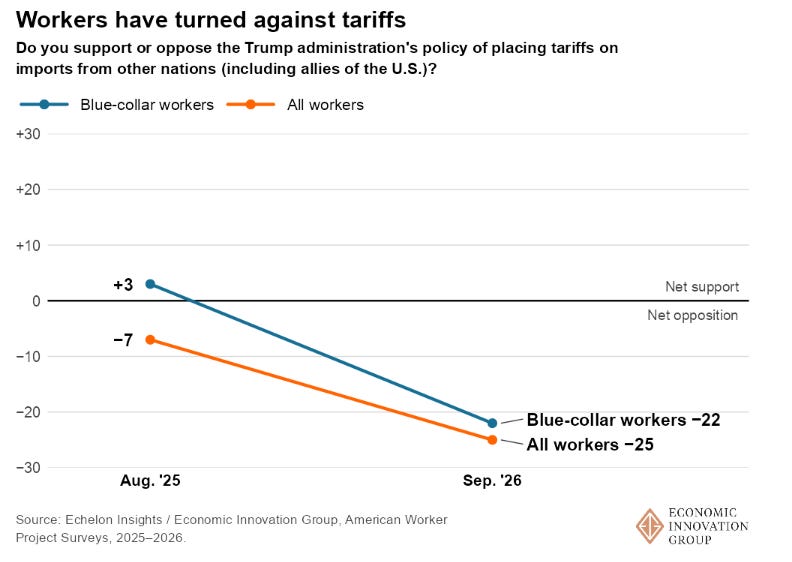
Workers’ opinions on trade, in particular, caught our eye. When we ran our survey last year, 50 percent of workers opposed the Trump tariffs, but a sizable 43 percent supported them. After a year experiencing the cost-of-living impacts, 59 percent of workers now oppose the tariffs, versus just 34 percent who support them.
The biggest red flag for Trump and the Republicans on this score comes from blue-collar workers. Last year, those workers supported the tariffs by a +3 margin. Blue-collar workers now oppose tariffs 58 percent to 36 percent, showing a 25-point net swing against the policy.
To read through our survey analysis, follow this link.
To jump straight to the survey slide deck, follow this one.
And check out media coverage of the survey:
Ben Casselman covered our American Worker Survey for the New York Times, quoting EIG president John Lettieri.
Grep Ip covered the survey for the Wall Street Journal, noting “the shift among the workers targeted to benefit from tariff protection.”
Madison Hoff covered it for Business Insider.
Ja’han Jones covered the survey for MS Now, highlighting its findings on the unpopularity of government ownership stakes.
And Eric Boehm gave the survey some love at Reason Magazine, writing that, “for conservatives, these polling data should end the tariff experiment. It has proven economically damaging, and it is no longer a political winner (if it ever was).”
Our own Jordan McGillis wrote an op-ed in the Journal’s October 19 print edition calling attention to the survey’s stark blue-collar findings.
One (More) Big Thing
KKR, one of the world's largest private equity firms, announced that it is banning noncompetes for employees making less than $100,000 across all of its portfolio companies. The company specifically credits EIG's noncompete research as the impetus for enacting this policy. KKR's portfolio companies employ over 800,000 people.
Policy
EIG submitted a comment letter to the Internal Revenue Service on behalf of its (EIG’s) Opportunity Zones Coalition regarding the agency’s proposed rules on new information reporting for Opportunity Zones. The coalition’s comments highlighted some potential challenges introduced by the proposed regulations and provided recommended solutions. You can read the letter here.
EIG joined the Center for American Entrepreneurship and the American Economic Liberties Project in submitting an amicus brief to the Wisconsin Court of Appeals arguing that an employer has legal standing to challenge an unlawful noncompete agreement for a worker they intend to hire. The case involves Veeva Systems, which sought to hire former employees from Epic Systems. The former Epic employees had noncompetes that prevented them from working for a competitor for up to 18 months and also contained stock penalties for up to two years. The amicus brief showcases the evidence that noncompetes undermine the productivity and growth of competing firms by restricting the available talent pool. It also shows that employees rarely challenge their noncompete in court, and that a more realistic avenue for contesting an unlawful noncompete is for the hiring employer to sue.
Research & Analysis
The Chart that Explains Work in America
Cardiff Garcia and Ben Glasner reveal the lessons for the labor market of the last four decades of real wage growth, zooming in and out of this chart:

One such lesson, they write, is that “fast wage growth and inclusive wage growth can clearly coexist. Indeed they hardly ever exist apart. The eras in which the median wage climbed at the steepest angle were those in which all the other wages climbed with it… Even if just a coincidence, the idea of a tradeoff between growth and inclusion seems a misguided and ahistorical way to think about the labor market.”
If demography is destiny, can communities change their fate?
Jiaxin (Jason) He, Kenan Fikri, and Ben Glasner discuss the two big trends in county population growth from the past several years:
Slowdown in large urban county population growth.
The large urban county population slowdown has now lasted about a decade. Big cities had enjoyed the strongest population growth of any category coming out of the Great Recession, but their advantage started to fade by 2016. The pandemic then hit large urban counties hard (remember the donut hole?) before they regained some of that lost ground as international migration picked up from 2022 to 2024. But then came the 2025 immigration crackdown, and big cities fell back to their low population growth trendline.
Shift to population growth for rural areas.
The other big reversal, this one in a positive direction, is for rural areas. After declining and then stagnating for much of the 2010s, rural population growth accelerated in 2021 and remains elevated compared to pre-pandemic growth rates. As illustrated in the figure below, the rural population increased by 2.1 percent from 2019 to 2025, up 2.3 percentage points from the six years prior. This rebound extended to small-town areas as well, where growth rates improved by 1.2 percentage points to 3.3 percent from 2019 to 2025.
But, they write, “rural portions of metropolitan areas drive most of the post-pandemic rural population growth. Despite making up roughly one-quarter of America’s rural population in 2019, rural counties within metro areas account for over two-thirds of total rural population growth since then.”
The American Dream Is Alive in the Midwest. For Now.
According to Jess Remington and Phoenix Vu, the Midwest is the most affordable region in the country. “Contrary to some popular narratives, this isn’t a story of depressed local economies reeling from deindustrialization or an opioid crisis with seas of vacant homes,” they write. “Housing is still affordable there, but only if the region keeps building.”

The fastest-growing metros are also electoral tossups
Ahead of the midterm elections, Kenan Fikri and Thomas Cronin find that the country's fastest-growing metro areas are also electoral tossups. Since President Trump took office, “Purple Metros — metropolitan areas where nearly equal numbers of residents voted Republican and Democratic in the 2024 presidential election — have enjoyed the strongest job growth of all.”

Around the Horn
In the Washington Post, Shira Ovide cited July research from EIG’s Jiaxin He on manufacturing jobs.
In a Bloomberg column, Scott Lincicome cited the same manufacturing jobs analysis from Jiaxin, plus December 2025 research from Jiaxin, Adam Ozimek, and Ben Glasner on the challenge of tallying them.
Also in Bloomberg, Allison McNeely cited EIG work led by Sam Peak and Catherine Lyons on non-competes and the new prohibition by KKR.
At Moneywise, Vawn Himmelsbach cited analysis from Ben on Americans’ retirement savings and the new Saver’s Match program.
J.R. Duren did the same in the Independent.
At Inside Higher Ed, Johanna Aloso quoted Sam on the problems with the Trump administration’s fee proposal for Optional Practical Training, a program that gives international students a bridge to the U.S. workforce.
At Bloomberg Law, Andrew Kreighbaum cited Sam and Jiaxin’s OPT fee analysis.
At Multi-Housing News, Dees Stribling reported analysis from EIG’s Jess Remington on the Midwest’s housing affordability advantage.
And lastly, for The Argument, Jordan wrote about the diverging family-formation trends among Millennials with and without college degrees.
The New Bazaar
Kristen Soltis Anderson, co-founder of the polling firm Echelon Insights, joins host Cardiff Garcia to discuss what American workers think about economic populism and the policies that are supposed to benefit them.
Drawing on Echelon’s recent survey of American workers on behalf of EIG, Kristen and Cardiff explore:
Workers’ growing opposition to tariffs
Frustrations over the cost of living and political corruption
Donald Trump’s weakening political brand
Unexpected trends on how Democrats and Republicans view Socialism versus Capitalism
What all of this might mean for the upcoming midterm elections
EIG Chart of the Month
The analysis of the labor market by Cardiff Garcia and Ben Glasner includes this chart showing the sudden stop of real wage growth just after Donald Trump took office. Just one more thing to think about ahead of the midterm elections.
