


One Big Thing
To generate the economic data that policymakers and the public rely on, the government’s statistical agencies use various methods to navigate a delicate balance between precision and the protection of privacy. As EIG research director Nathan Goldschlag explains in a new Agglomerations post, the Commerce Department has now banned the use of one such method, making the production of quality data more difficult.
On June 4, Commerce banned a practice called “noise infusion,” a vital tool that statistical agencies use to provide granularity without violating the privacy of the businesses and individuals from whom it collects information. Noise infusion, Goldschlag explains, is the practice of slightly altering data in order to preserve both the general accuracy of the data and the identities and proprietary information of private-sector actors.
In the example he offers, noise infusion can be used to “fuzz” a business’s employment numbers to preclude their rivals from gaining competitive intel. He presents the hypothetical of a county with a small number of breweries. If the owner of one brewery is able to infer the number of employees its rivals have by a process of elimination, that owner might be able to operationalize an advantage. Noise infusion changes the specifics ever-so-slightly in order to give a useful picture for researchers and policymakers without disclosing too much on any given business.
The motivation behind the ban is likely that Commerce wants to improve the precision of the data that statistical agencies generate. Removing noise infusion, however, will have a different effect. Because the agencies are legally bound to confidentiality, they will have to resort to broader aggregations, such as at the state level, rather than at the county or municipal level. Businesses themselves may also end up withholding a lot more information in their survey responses on the front end. Perhaps worst of all, the statistical agencies will be forced to stop publishing certain data series altogether.
Noise infusion is a vital way to balance between granularity and privacy. Commerce’s blunt ban — “Noise infusion shall not be used for any statistical product” — undermines the ability of the agencies to provide researchers and policymakers with the best data they can. Policymakers should take note and read Nathan’s post.
Policy
John Lettieri, President and CEO of the Economic Innovation Group, was quoted in the New York Times responding to the passage of the 21st Century ROAD to Housing Act, arguing that the bill is a welcome step towards addressing the nation’s entrenched housing shortage — but far from the final step:
“I think the American people are running low on patience broadly on this issue, and that has been true for years...”
Mr. Lettieri said the bill was not “the magic fix-it-all button” on housing “that people would love to see pushed here.” But he said the measure was still a rare and significant achievement that would “show demonstrable progress.”
EIG also issued a statement praising the bill, encouraging Congress to continue playing a central role in helping communities build at the scale the moment demands:
EIG remains committed to advancing research and policy ideas, such as Right to Build Zones, that make housing abundance a national priority and expand access to opportunity. The 21st Century ROAD Act is an important first step, but there is still work to be done.
Tina Lee, Jess Remington, and Adam Ozimek recapped a convening about Right to Build Zones hosted by EIG in March of this year. “The goal of the convening,” they write, “was to strengthen the policy’s structural design with input from leading experts, practitioners and industry.” The guests included several members of EIG’s housing advisory board: Scott Alter, Alex Armlovich, Bobby Fijan, Arpit Gupta, Paul Williams, Emily Hamilton, Michael Novogradac, and Mike Kingsella.
Around the Horn
John Lettieri was also quoted by Bruce Golding in The Independent about the 21st Century ROAD to Housing Act.
The Economic Innovation Group is proud to be a partner of this year’s Abundance Conference.
In Newsweek, Billal Rahman, highlights a new report that examines earnings linked to high-skill immigration using EIG data.
In The Hill, AEI’s Brent Orell cites work from EIG research director Nathan Goldschlag and former research associate Sarah Eckhardt on AI’s labor-market impact.
Research & Analysis
AI versus the China Shock
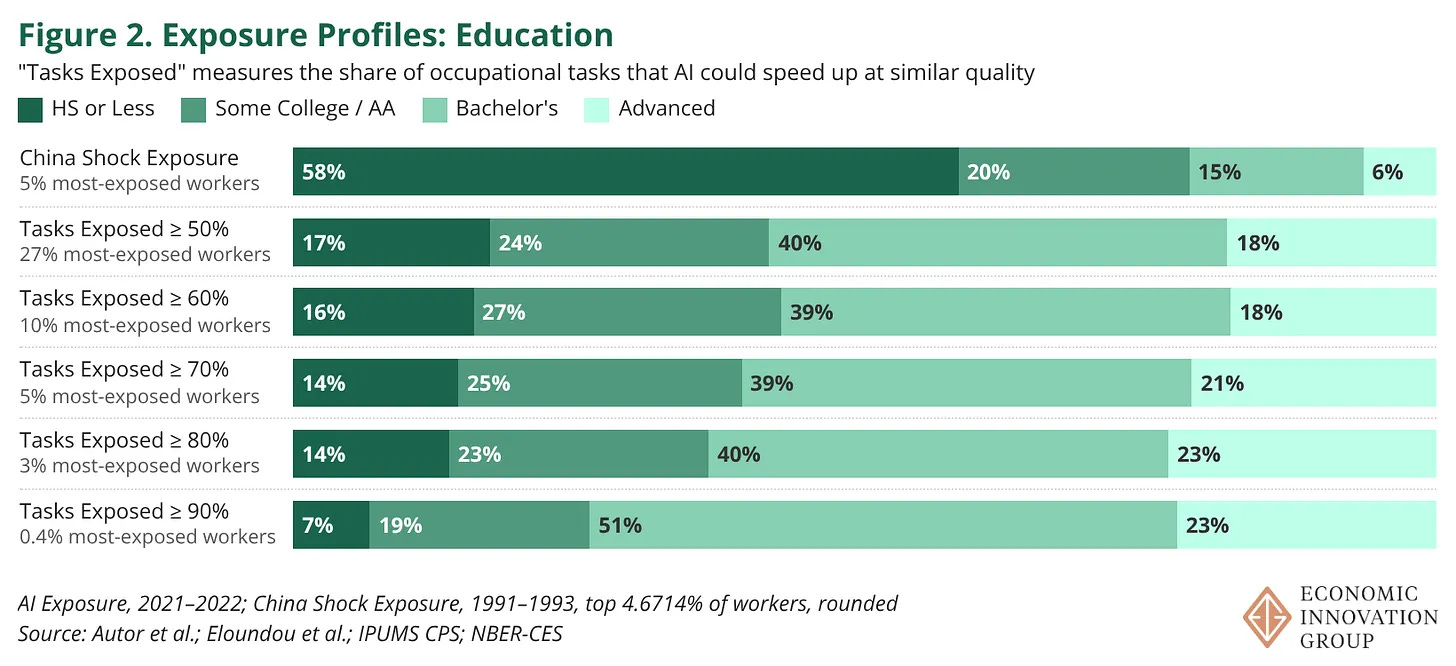
Adam Ozimek, Jason Harrison, and Nathan Goldschlag ask: Will AI do to laptop workers what the China Shock did to so many factory workers? “Hoping to avoid the same mistakes of the past,” they write, “researchers and policymakers will be tempted to say yes. But after a closer look at the details of the China Shock, combined with our understanding of workers exposed to AI, we arrive at a different conclusion. The real lessons of the China Shock emerge not from its similarities with the AI Shock, but from its differences. And these lessons should mitigate concerns about a massive upcoming disruption, not exacerbate them.”
AI Shocked workers are likely to be better educated, have higher incomes, and live in more places with high levels of human capital — all of which contribute to far greater resilience than their China Shocked predecessors.
The New Bazaar
AI Shock vs China Shock: Adam Ozimek and host Cardiff Garcia chat about Adam’s new analysis (see above) contrasting the characteristics of China Shocked with those of workers likely to be affected by the AI Shock. They also discuss how to think about automation, the collection of tasks that make up a job, the resilience of “messy” jobs, and much more.
A City from Scratch: California Forever has a bold and ambitious plan: to erect an entire new city in California, from scratch, about a one-hour drive north of San Francisco. It has bought about 70,000 acres of land in Solano County, and it was the city to be two things: 1) an urbanist, walkable city of about 400,000-500,000 people, zoned for density instead of suburban sprawl, and located in a place where you would not expect to find it; and 2) a tech manufacturing center, with new factories making actual physical stuff, and a big shipbuilding operation. Cardiff is rooting for it to succeed, but he also had questions. Jan Sramek, Founder and CEO of California Forever, was exactly the guest to answer them.
Debt and Deficits: Time to Worry?: Martha Gimbel, executive director of The Budget Lab at Yale, returns to the New Bazaar to chat with Cardiff about all things debt and deficits. Martha argues that the fiscal choices of the past decade have already led to higher costs on mortgages, car loans, and small-business debt. She and Cardiff discuss what might happen next given the frightening projections for future borrowing.
EIG Videos of the Month
Ben Glasner comprehensively summarizes the new retirement policy from the Trump administration to expand access to retirement accounts:
Also, did you know that the New Bazaar now also does video episodes? Here is Cardiff Garcia’s chat with Martha Gimbel, available on EIG’s YouTube page, where you’ll find all full episodes of The New Bazaar in addition to shorter clips: