
One Big Thing
Despite its nominal commitment to advancing U.S. innovation as a means to greater prosperity and global competitiveness, the Trump administration is implementing immigration policies that directly counteract those aims.
Specifically, the administration has proposed a levy of $100,000 on international students graduating from U.S. universities who apply for the Optional Practical Training (OPT) program and has reasserted its $100,000 fee on applicants for the H-1B visa (revising it upward to $103,265).
As Sam Peak and Jiaxin He explained in the wake of the OPT fee announcement, deterring graduates from U.S. universities will not only reduce their probability of entering the U.S. labor force, it will also entrench some of the perverse outcomes of the existing skilled-immigration system, biasing it in favor of less-skilled workers and the notorious “outsourcers” that hire them. The OPT program is a vital bridge that connects new grads to the labor market on a short-term basis, to the wider benefit of the American economy.
The H-1B program, though flawed, can best be improved through reforms that filter for the immigrants who create the most economic value. The most important changes pertain to the lottery system that allocates H-1B visas. Though the administration has made changes to the lottery, we contend that its “Wage Level” reforms are vastly inferior to an alternative approach, “Experience Benchmarking.” Experience Benchmarking, as Sam and Jiaxin wrote in a letter to the Department of Labor in May, “ensures all certified H-1B workers earn more than the median wage of comparable native-born workers with equivalent education and experience.”
While both the OPT program and the H-1B visa require reform to maximize their potential (see our other ideas here, here, and here), the administration’s punitive approach is a frontal attack on them. Curtailing, rather than improving, these skilled-immigration pathways undermines the immense productivity, wage-growth, business-formation, and technological benefits that America derives from its historic position as the world’s top destination for talented workers.
Research & Analysis
Understanding AI and Productivity
Chad Syverson, an economist who specializes in productivity and the George C Tiao Distinguished Service Professor of Economics at the University of Chicago Booth School of Business, contributes a guest essay to EIG’s American Worker Project looking at what is known to this point about the relationship between Artificial Intelligence and productivity growth.
An excerpt:
So, do the early data offer any hints as to which combination of these multiple considerations about AI’s employment effects may apply going forward? Early empirical studies of AI applications in production actually offer minimal evidence either way. At least over the first couple years of its use, AI has had remarkably little employment effect, positive or negative. While that may seem on its face to be a non-informative result, the very fact that there have been no obvious employment effects yet does say something about the combined effects to this point.
The New Bazaar
Top Five Unpopular (But Totally Correct) Beliefs
EIG Chief Economist Adam Ozimek joins host Cardiff Garcia to share his five favorite unpopular beliefs. Adam believes these ideas are true, even if others may find them contentious, perhaps even contemptible.
Adam tries to persuade Cardiff and New Bazaar listeners that…
Prediction markets are going great
Economists should ignore the efficient market hypothesis in their own lives
The United States should let Chinese cars in
One Billion Americans is absolutely a goal the country should pursue
Consumers should spend less money on cars
Adam and Cardiff also consider when contrarian thinking is useful and when provoking disagreement becomes a brand rather than a way of getting closer to the truth.
Around the Horn
In City Journal, Adam Ozimek argues alongside IFP’s Jeremy Neufeld that the Trump administration’s proposed $100,000 fee on Optional Practical Training applicants is a clumsy misstep that will squander immense economic value.
In Reason, Billy Binion quotes work from Sam Peak and Jiaxin He on the same topic.
In Forbes, Teresa Ghilarducci cites research from Ben Glasner and Sarah Eckhardt on worker retirement plans.
In Bloomberg, Erin Schilling cites the EIG Opportunity Zones Coalition’s comments to the Treasury Department.
In Forbes, Marie Sapirie quotes Kenan Fikri on OZ designations.
In Realty Today, Sebastian Niles cites EIG data in its New York OZ coverage.
Jiaxin He and Adam Ozimek draw citations from Stuart Anderson in Forbes and Billal Rahman in Newsweek for their paper critiquing the empirical basis of the Trump administration’s H-1B fee.
And in a Financial Times letter, Jordan McGillis rebuts columnist Rana Foroohar’s claim that America’s economy only benefits the rich.
EIG Chart of the Month
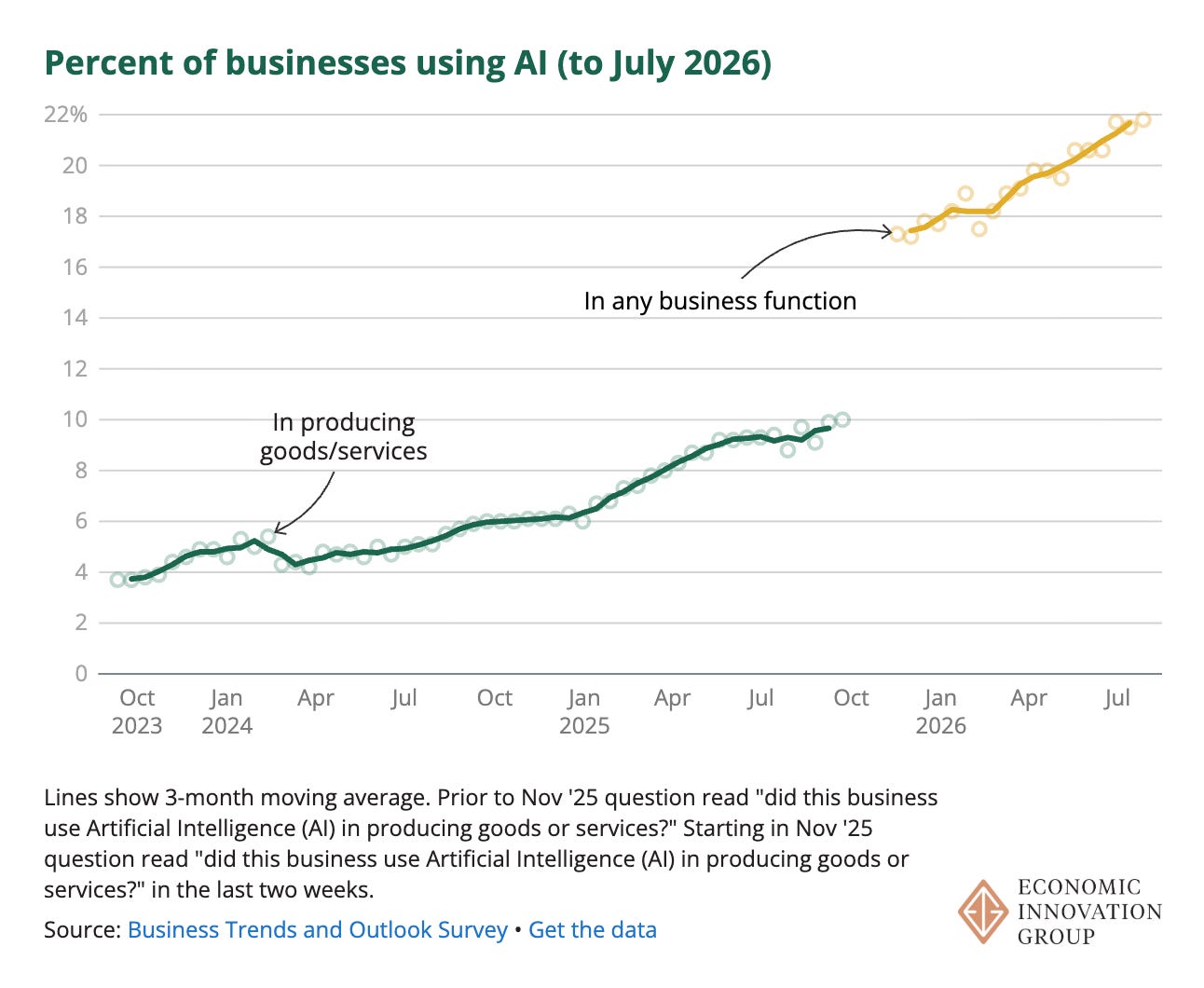
Via EIG research director Nathan Goldschlag’s dashboard, the share of businesses using AI in any business function is just north of 20 percent: