


This is the second entry in our series about the wage subsidy. We also have produced a series of short videos about the policy, which you can find at our YouTube and Instagram pages.
In Part 1 of this series, my co-authors and I noted that the American labor market has a longstanding problem:
Roughly 21 million American workers earn less than $16 an hour. Two-thirds of those workers are women. And among men in their prime working years (ages 25–54), nearly 10 million, or 14 percent of them, don’t have jobs at all. In some states, like Louisiana and West Virginia, one out of five working-age men are jobless.
In short, the labor market has left too many people with either low pay or no pay at all.
We proposed a straightforward solution, a wage subsidy.
We were delighted by the response to our suggestion, both from readers who liked the idea and those who were critical. We also received many, many questions about the economics of the idea and how it would work, including from a number of economists. We respond to those questions in this post.
Refresher question: What is a wage subsidy?
A wage subsidy is a publicly funded top-up to low hourly wages. Our proposal outlined a subsidy equal to 80 percent of the difference between a worker’s employer-paid wage and a target hourly wage set at 80 percent of the national median ($16 in 2024).
This chart is the simplest way to see the amount of the subsidy for a given employer-provided wage level:

Rather than setting an ever increasing new minimum wage, it supplements the wages of lower-paid workers directly, increasing hourly earnings without making it more expensive for employers to hire. A wage subsidy also boosts the supply of labor by improving the financial return to work for those in low-paying roles without undercutting labor demand.
The structure is simple, market-oriented, and targeted at the low end of the wage distribution. For further details on its design, please read Part 1. Now on to the most common questions sent to us by readers.
Q: Wouldn’t employers just reduce base wages and rely on the subsidy?
Several forces would limit employer wage-cutting.
Because of the “80–80” structure, reducing base wages always means reducing a worker’s overall take-home pay. For example, a worker earning $10 per hour would see their compensation rise to $14.80 under the subsidy. If the employer cut the base to $8 per hour, the worker would then receive $14.40 in total — still an improvement over $10, but a decline from $14.80.
Two countervailing forces are important:
Worker Perception and Retention: Workers respond to changes in take-home pay. Once the wage subsidy is in place, a drop from $14.80 to $14.40 will be viewed as a cut, because that’s what it is. That perception creates reputational and retention risk for employers.
Market Competition: Because the wage subsidy applies to all employers, any single employer who looks to capture portions of the wage subsidy by undercutting pre-subsidy wages risks their most productive workers being scooped by their competition. Wage competition remains active and tethered to worker productivity, even with the subsidy in place.
Ultimately, wages are shaped by the interaction of labor supply and demand. To the extent that a wage subsidy increases the supply of labor, by raising the effective return to work and making low-wage jobs more attractive, it will exert downward pressure on employer-paid wages. But employers do not set wages unilaterally or independent of market forces. As outlined in the appendix below, they must still compete for workers in a dynamic labor market. Importantly, for any job that qualifies for the subsidy, the total compensation received by workers will exceed pre-subsidy levels, even if the part of take-home wages that’s paid by employers adjusts downward.
Furthermore, while firms with monopsony power may currently have greater ability to capture benefits targeting workers, those advantages are likely to erode under the wage compression introduced by the wage subsidy. As illustrated in the figure below, the 80–80 wage subsidy significantly narrows the wage distribution below the $16 target, effectively bunching workers near or at that threshold. This compression enhances competition across employers who previously occupied distinct rungs of the wage ladder. Even firms with market power face increased pressure to offer competitive effective wages1 and total compensation, limiting their ability to retain workers while paying substantially less than peers.
The result is a labor market in which subsidy benefits are more broadly shared and monopsonistic mark-downs are harder to sustain.

What might happen:
Jobs on the margin that would not otherwise exist due to low productivity may see a boost in hiring as workers’ reservation wages2 and employer-provided wages could see the gap covered by the subsidy. This would allow employers to hire or retain workers at a lower base wage, but with higher offers of hours, hours stability, and non-wage benefits. All of those non-wage aspects of compensation would still occur in the context of the policy, which ensures that total compensation remains above today’s levels.
This is a feature of the policy: it creates more viable job opportunities in low-wage sectors and geographies without pushing workers deeper into economic precarity.
Q: Does this amount to a corporate subsidy for large employers?
Not in the way “subsidy” is commonly understood.
Unlike traditional economic development subsidies — which often target specific firms through opaque negotiations — a wage subsidy is:
Job-based, not firm-based: Any employer paying below the target wage qualifies, whether they operate a national chain or a small local business.
Conditional and transparent: Only workers actively employed in eligible roles trigger the subsidy, and the benefit flows directly to them, not their employer or an alternative intermediary. While firms will see a benefit to the publicly funded top-up to low hourly wages, that benefit only occurs in the context of an employer-employee match. The jobs need to exist and be taken for any benefit to accrue.
Neutral in application: Many jobs at large employers already pay above the target and would not receive a subsidy. Where large firms do benefit, their workers do as well through higher take-home pay.
Moreover, the structure of the program encourages a more equitable distribution of public support. A wage subsidy would direct more resources to distressed regions and lagging labor markets with high shares of low-wage work.
Q: Because the amount of the wage subsidy declines as employer-paid wages increase, doesn’t the wage subsidy therefore represent a tax on raises? Or as economists would say, isn’t it an increase in the effective marginal tax rate?
The subsidy is designed so that within a specific band of wages (approximately $7.25–$16), a $1 increase in employer-paid wages reduces the subsidy by $0.80. That means only $0.20 of the raise appears in take-home pay. That is definitely something to be thinking about, but it is not an increase in the effective marginal tax rate.
Unlike a policy in which the effective marginal tax rate increased, the wage subsidy:
Has no penalty on hours: The subsidy is wage-based, not income-based, which means that it scales linearly with hours worked. A worker who increases their hours from 20 to 40 per week, and their income as a result, sees their take-home pay double. That happens without any benefit reduction, unlike many income-tested safety net programs.
Has no household-level phaseout: The benefit is job-based, not income-based. A worker’s subsidy is unaffected by their spouse’s income or other jobs they might work. This avoids the complexity and disincentives embedded in many means-tested policies.
Still yields higher take-home pay when a worker gets a raise: While the marginal return to a raise is reduced within the band, every dollar of employer wage still increases total compensation. There is no earnings cliff or net loss.
Treats all work independently: The subsidy is applied job-by-job, not person-by-person. So if a worker has multiple jobs that each pay different wages, for example, one at $8 per hour, another at $10 per hour, and a third at $15 per hour, they would receive distinct subsidy amounts for each. The formula applies independently to each position, regardless of the worker’s total income or total hours worked. This structure distinguishes the wage subsidy from income-tested programs like SNAP, the EITC, or Medicaid, where benefits phase out or disappear as total income (the sum of all earnings across all jobs) increases. Effective marginal tax rates apply at the tax filer level, which of course considers total income, not hourly wages. In contrast, a worker can simultaneously receive the maximum possible wage subsidy on a job paying $7.25 per hour and a minimal subsidy on a second job paying $15.95 per hour. Once again this job-by-job treatment underscores the point that the policy does not impose a rising effective marginal tax rate. Instead, it treats each job on its own terms, reinforcing work incentives across the income distribution without penalizing workers for taking on additional hours or employment.
In short, while the subsidy reduces the marginal return on raises within the band, it does not actually increase workers’ effective marginal tax rate. Instead, it reshapes how compensation is delivered. Employers have the option of leaning more on non-wage benefits — more generous health insurance, access to and matching in retirement plans, more predictable scheduling, and greater flexibility in how work is organized — all layered on top of a stronger cash earnings floor for workers.
One of the most pressing concerns of worker advocates has been, and continues to be, closing the gap in access to non-wage benefits across the income and wage distribution. The wage subsidy’s compression of the wage distribution at the low end would help to close this gap via the flexible and responsive market mechanism rather than an administratively burdensome and distortionary mandate.
Q: Can the government actually administer a wage subsidy?
Not today, but the gap is manageable, and the required infrastructure is well within reach.
Current wage reporting systems — Form W-2 (annual), Form 941 (quarterly, employer-level), and state UI wage records (quarterly, some with hours) — are insufficient for administering a per-paycheck subsidy. What’s missing:
Pay-period level data
Standardized reporting of hours and wage rates
A reimbursement mechanism tied to those records
Two paths forward are viable.
1. Voluntary opt-in via payroll software
Employers (or their payroll providers) would:
Report pay-period data (hours and wages) for eligible workers.
Calculate the subsidy in payroll software.
Display it clearly on pay stubs.
Receive reimbursement automatically from the government.
This approach would likely begin with large firms and payroll providers, expanding coverage over time. Its strength lies in speed and voluntary engagement, though early coverage would be incomplete and favor firms with higher administrative capacity, either in-house or through a payroll provider.
With time, as the infrastructure improves, an on-ramp can be made for smaller, younger, and less technically capable firms to adopt the subsidy as well. It would be reasonable to assume that adoption at the firm level would increase with time due to competitive pressures on hiring.
2. UI wage record modernization
States already collect quarterly wage data for unemployment insurance. A federal investment could:
Standardize reporting to include hours and wage rates.
Accelerate reporting timelines to monthly or bi-weekly.
Use enhanced UI records to calculate and reimburse subsidies at the quarterly level instead.
Though this option involves more upfront administrative load, it would build durable infrastructure useful for multiple federal programs — including unemployment insurance, workforce development, and labor market analytics. Not all of those benefits are exclusive to a UI modernization effort, but it would open the door to other highly valuable updates to our UI system.
Q: How does this interact with the EITC, CTC, and broader worker-family policy?
The U.S. currently relies heavily on the Earned Income Tax Credit (EITC) and Child Tax Credit (CTC) to serve multiple policy goals — supporting low-wage work, subsidizing families with children, and providing proxied regional assistance (because of the heavy concentration of low-income residents and struggling labor markets in certain parts of the country).
This bundling creates design and equity challenges.
For example:
A childless adult earning $15 per hour receives little from the EITC, while a parent earning the same amount may receive several thousand dollars.
Both the EITC and CTC are delivered as annual lump sums at the end of each year — powerful for poverty reduction, but disconnected from weekly financial needs.
The wage subsidy simplifies the equation:
It is job- and hour-specific: If you work in a low-wage job, you receive the subsidy — regardless of family status or household income.
It shows up in the paycheck, not months later.
It complements rather than replaces family-based supports.
It is defined as pre-tax and pre-transfer cash, like any other dollar earned, allowing for a natural targeting due to the inherent structure of our income tax brackets. This would also help many of our lowest wage workers overcome high benefit cliffs by earning enough to pass through them.
While beyond the immediate scope of our initial proposal, it is possible that a world where the wage subsidy exists would help facilitate an unbundling of multiple policies, allowing for a cleaner and more effective safety net.
Q: Why not just raise the minimum wage?
Minimum wages and wage subsidies may sound similar, but they operate on very different mechanisms.
Like the minimum wage, the wage subsidy acknowledges that our social goals may go above and beyond what market mechanisms can provide on their own. This is especially true where employers cannot afford to pay more due to low productivity or local economic conditions.
But raising the minimum wage too far above productivity in distressed, lagging, or rural labor markets risks excluding workers from employment entirely. Minimum wages act to shut out a portion of potential employer-employee job matches. How many are excluded depends on the level of the wage set, inherently limiting the capacity of policymakers to lift the bottom of the wage distribution, for fear of undercutting support through disemployment effects.
A wage subsidy, by contrast, covers the gap between what an employer might be willing to pay and what an employee might be willing to work for. This increases the set of potential employer-employee matches that could occur in a labor market, greasing the wheels of economic activity.
Geographically, the distinction is critical. A $16 per hour minimum wage is modest in New York City, San Francisco, or Seattle but potentially destabilizing in rural Appalachia. A wage subsidy, by contrast, adapts automatically: it delivers more support in regions with lower market wages, channeling public investment where it is most needed and helping jumpstart the economies that have fallen the furthest behind.
Q: Does this cover gig workers?
The initial proposal focuses on W-2 employment, where wage and hour data are verifiable and there exists an infrastructure of labor regulation. This ensures program integrity and minimizes fraud risk.
Independent contractors and gig workers present more complex challenges due to the difficulty of verifying hours, wages, and classification.
Firms that host platform-mediated gig work (e.g., Uber, DoorDash) have argued that platform participants are not employees, and would therefore under our proposal not qualify. It is possible that these workers could be incorporated into the wage subsidy over time by requiring those platforms to report standardized pay-period data and adopt an employee classification, helping balance some of the costs to platforms from re-classifying platform workers as employees.
What it all means
A targeted wage subsidy offers a powerful, scalable approach to improving the quality of low-wage work in the United States. It raises take-home pay, preserves employment incentives, and channels public investment toward the workers and communities most in need.
It is not a silver bullet. But it is a disciplined, transparent, and place-sensitive policy tool, one that belongs at the center of a modern economic agenda focused on work, dignity, and broad-based opportunity.
APPENDIX — CHARTS AND GRAPHS FOR THE ECON NERDS
We know that the economists among you will insist on seeing these concepts in more fundamental terms of labor supply and demand. We’re happy to oblige. The rest of this appendix is addressed directly to them, using their language (which is also our language, frankly).
Here’s the place to start:
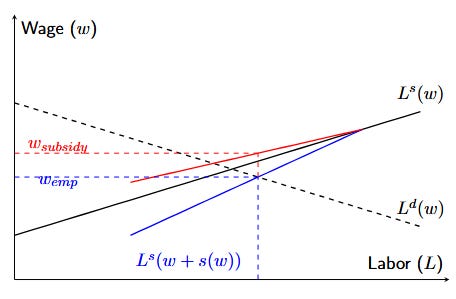
A wage subsidy raises the effective wage that workers receive without raising the wage that employers pay.
In our policy design, the subsidy is a simple top-up. If an employer wage falls below the target wage then public funds pay:
That shifts a worker’s budget constraint from
to
It steepens the “price of leisure” as if the worker faced a higher wage. The textbook prediction is then straightforward: because work pays more at the margin, labor supply increases both at the intensive margin (more hours among those already working) and at the extensive margin (entry among those whose reservation wage is now below w+s(w)).
On the employer side, none of this changes the firm’s marginal cost of labor, because firms still pay w, not w+s(w). In a standard competitive setup, firms hire labor up to the point where the value of the marginal product equals the wage (e.g. P⋅ MPL = w). Since the subsidy is not changing w, it does not shift the labor demand curve. Instead, any adjustment shows up as movement along the existing labor demand curve when the market-clearing employer wage changes.
When we put those two things together, we get the post-subsidy labor supply and labor demand curve above. For wages where s(w) > 0, the labor supply curve shifts to the right because workers behave as if the wage is w+s(w). The new equilibrium features higher employment and (in the frictionless competitive incidence case) a lower employer-paid wage than before, called w_emp, because the market is clearing with more labor than before. We have moved down the labor demand curve. Workers do not experience a lower wage though. The post-subsidy received wage is:
which is greater than the employer provided wage for values of w where s(w) > 0.
“Effective wages” include the combined employer-paid wage with the wage subsidy.
A reservation wage is roughly defined as the lowest wage a given person will accept to enter the labor market and take a job. If Mike won’t take a job for less than $10 an hour but a nearby employer only has openings for $8 an hour, then Mike stays out of the labor force. If a wage subsidy then increases the take-home pay that Mike would receive from that job to $14.40, then Mike will apply for the job.
Should we consider more science fiction ideas, such as installing computer chips in employees' brains? It seems unreasonable to subsidise wages, because the investment multiplier is too low.
Yes please, do this. No notes. Helps people where they need it.