


Everyone hates the fiscal deficit, but no one wants to do anything about it.
The problem, of course, is that addressing the deficit proactively jeopardizes politicians’ favorability with voters. What if, however, there were a politically popular way to shore up fiscal balances at the federal, state, and local levels without taxing citizens more or cutting their services?
In fact, such a mechanism exists today, in the form of high-skill immigration.
In a new EIG report, my colleagues Adam Ozimek and Sarah Eckhardt demonstrate that H-1B immigration has an immediate and positive fiscal impact. Ozimek and Eckhardt analyze the taxes that H-1B immigrant households — the most numerous in the high-skill category — pay to federal, state, and local coffers, and the benefits they draw from the public budget. They find that each H-1B household has an average positive federal fiscal impact of $30,050 per year, a figure that is 2.6 times greater than that of the average American household. Moreover, at the state-and-local level, the average H-1B impact is over $5,040 annually.
In other words, oft-maligned H-1B workers are plugging the federal deficit and replenishing strained state finances. How?
H-1Bs are remarkably net-positive for two main reasons. First and foremost, they make a lot of money. H-1Bs are very well-paid compared to the average worker because they work, almost exclusively, in high-wage, in-demand sectors like tech and medicine. With an annual income of $130,075, the median H-1B worker earns at the 91st percentile nationally.
The second reason H-1Bs contribute so robustly to government finances is demography. More than 60 percent of H-1B recipients are under the age of 35, which means that H-1Bs tend to consume very little in the way of public services.
Demography does, though, cloud the fiscal impacts of one subset of H-1B workers: those with a dependent spouse and children, a group that makes up 25 percent of H-1B households. While they are still net-positive at the federal level, H-1Bs who bring with them a spouse and children are a net fiscal negative at the state and local level due to state spending on public education.
Critically, this negative fiscal impact mirrors that of Americans of similar age, income, and fertility. Until reaching an income of $250,000, single-earner American families with children, too, are net fiscal negatives at the state level. All of these facts point to a promising reform: authorizing the spouses of H-1Bs to work too.
Reforming the H-1B program to include work authorization for all H-1B spouses — who themselves enter the country on H-4 visas and are generally barred from working — would amplify positive fiscal impacts and reduce the fiscal drag introduced by the one-quarter of H-1B households that currently have children and just one earner. Because H-1B spouses tend to be comparably skilled to the visa holders, our report finds that authorizing them to work would boost the average positive fiscal impact of an H-1B household by 50 percent, to $45,850 at the federal level and $7,670 at the state-and-local levels. Our report also finds that by authorizing work for H-1B spouses, even H-1B families with children would become net fiscal positives in most states.
Another high-leverage reform opportunity is to alter the way we select H-1Bs. The current system is a pure lottery, provided H-1B applicants meet the basic educational and occupational criteria. We propose ending the lottery and enhancing the composition of H-1B cohorts by selecting applicants based on a wage ranking system that rewards age-adjusted earnings. Wage ranking the selection process would alone boost the fiscal impacts per H-1B to $48,700 at the federal level and $7,980 at the state-and-local levels.
Together, selecting H-1B applicants based on wage ranking and authorizing their spouses to work would push their net fiscal impacts each year to $65,020 at the federal level and $10,650 at the state-and-local levels.
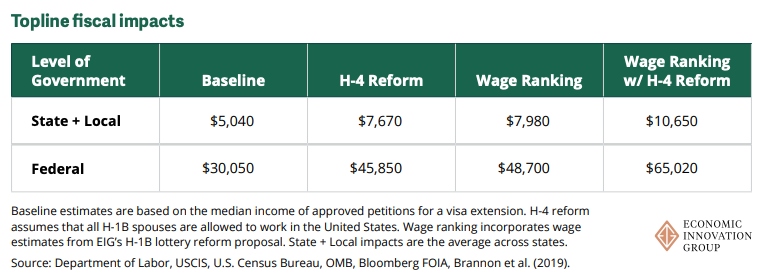
The H-1B program has taken heat from conservatives and progressives alike in recent years, yet this report shows that the roughly 700,000 H-1B visa holders in the country at this time are of enormous fiscal value, generating a cumulative federal net fiscal impact of around $20 billion each year. Our proposed reforms would double that figure to $40 billion and provide an ongoing revenue stream, unlike the Trump administration’s one-time $100,000 H-1B fee, which does not directly address the program’s composition problem. It’s important to note that this profound, direct, near-term fiscal impact does not even factor in the tertiary economic benefits of the program that stem from increased innovation, entrepreneurship, and productivity growth. These well-documented spillovers indirectly boost tax revenues even higher in the long term.
As the nation careens toward fiscal crisis, the H-1B program should not only be judged on innovation grounds or on cultural grounds, but on the unifying goal of getting our federal, state, and local budgets in order. Improving the program by picking the best applicants and authorizing their spouses to work is a rare, politically-palatable way to plug fiscal gaps.
Will you write something similar to defend workers when AI comes for coding jobs or only this because your benefactors want the H-1Bs?
H-1Bs are a subsidy for American corporations and the program is structured so as to hurt innovation.
I’d rather Americans pay into America’s coffers. You wouldn’t be losing a large percentage to remittances either.
That's right, exacerbate the work climate, i.e., lost job opportunities and stagnant wages, for IT and other AMERICAN workers so greedy CEOs can have more cheap labor.