

To hear an extended conversation about the themes in this post, please subscribe and listen to our podcast, The New Bazaar.
Either AI is so useless that we are in the middle of a bubble that’s about to burst and take the economy down with it, or AI is so powerful it’s going to replace us all and devastate the labor market.
The pessimism in speculation about the economic effects of artificial intelligence is often so overwhelming that these opposing concerns can even come from the same person. AI is evolving fast enough that we should not entirely ignore the economic doomers, though it would be nice if they could at least be consistent.
But it is essential to balance the discussion with some optimism. I can see glimmers of hope in a simple fact: There are many jobs and tasks that easily could have been automated by now — the technology to automate them has long existed — and yet we humans continue to do them. The reason is that demand will always exist for certain jobs that offer what I call “the human touch.”
The specific jobs that require the human touch may themselves change or evolve, but I suspect that such jobs will continue to exist long into the future.
The music never stops
To understand why, we begin with an example from the past. The distant past.
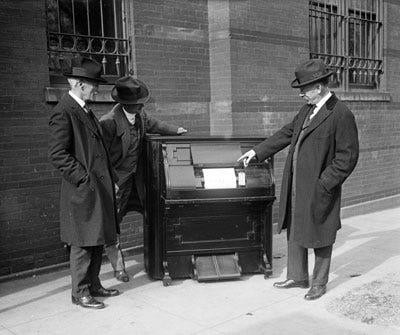
The player piano, or pianola, was invented by Edwin Votey in 1895. At first it was a stand-alone machine that would be pushed up against an existing piano, like the one shown below.
Within a few years, player pianos could be built into the pianos themselves. The machines “read” music that was encoded onto rolls of paper. The notes were represented as holes in the paper that directed pneumatic airflow, which then pushed down the levers that depressed the piano keys.
The only role for humans to play in the functioning of a player piano was to pump the pneumatic foot pedals to keep the piano playing. No need for a skilled human piano player.1
And yet, despite the technology to fully automate the job having been invented more than a century ago, people still make a living playing the piano today.
The job is not just limited to piano players performing in ticketed concert events, which of course are quite common. Hotels, bars, and restaurants continue to hire live piano players to provide background music as if it was 1894, the year before the invention of the pianola, which itself is hardly ever used anymore.
Listeners simply prefer music from a piano player rather than a player piano.
The greater competition for live musicians these days comes from a different and a far less literal type of automation: music recordings.
The act of creating recorded music obviously requires human musicians. But once the music exists, it is easy to fully automate what could otherwise be a live musical performance. Like the player piano, this form of automation has been around for a very long time. Thomas Edison invented the phonograph in 1877. The first commercial version was released in 1895.
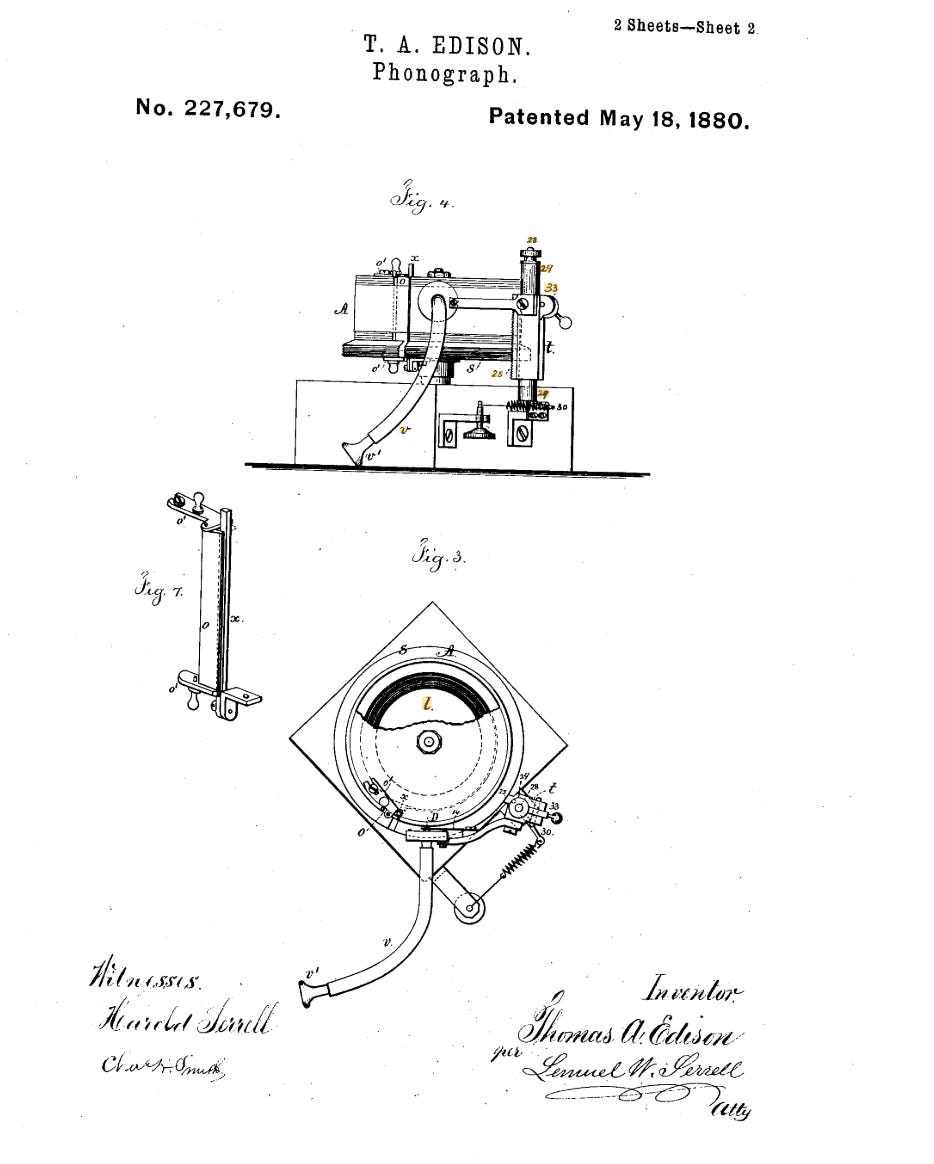
From tinfoil phonograph cylinders to Spotify today, live music has long faced competition from recorded music, which over time has been produced at lower and lower cost and heard by listeners with greater and greater convenience.
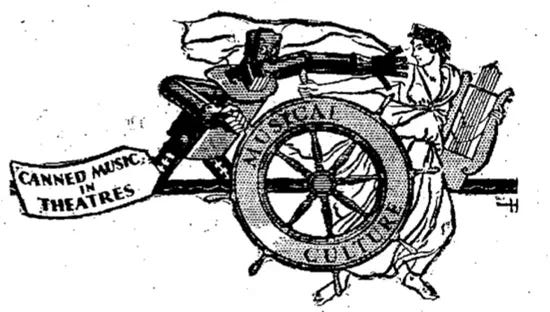
This competition has aroused plenty of worry in musicians through the years. In 1927, the movie The Jazz Singer debuted as the first full-length movie with synchronized recorded music. It pointed to the eventual end of silent movies — in addition to the need for the live musicians to accompany them. Musicians panicked. The Music Defense League was launched to spend hundreds of thousands of dollars campaigning against “canned music,” arguing that it would take work from musicians.
And yet despite 130 years of automation and the continued rise of “canned music,” live music performances are ubiquitous today. The demand for them is not limited to the upper reaches of talent, such as violinists playing Schubert in a concert hall,2 or superstars like Taylor Swift. While top tier performance artists are as in demand as ever, so too are those at the bottom of the quality spectrum.
So high is the demand for live human music that there are now more than 200,000 individuals employed as musicians or composers across the United States — more than at any time back to 1850.

Consider that recordings of the greatest musical acts ever, and indeed some of the greatest live shows ever, can be heard almost for free thanks to the magic of technology. Nevertheless in almost every town in the United States, the very night you are reading this sentence, terrible bands are being paid to perform live in bars. Good bands, too. They just aren’t playing during the matinee in your local movie theater, to the dismay of the Music Defense League.
Why haven’t most of these jobs been automated? Why is it that the piano player remains when the piano playing automaton has been around for a century? Why is it that people would rather listen to a bad bar band than the masterpiece that is the recording of Johnny Cash playing Live At Folsom Prison from 1968?
The demand for the human touch is visible in other parts of the arts and entertainment sector as well. Many people fear that AI will replace human actors. But CGI has been technically capable of replacing human actors and special effects for some time. Audiences dislike the uncanny valley that often results, and Hollywood still uses practical effects like blowing up actual airplanes. I would bet on the continued existence of both Broadway and demand for human film actors. Something about the experience of watching performances makes the audience simply prefer to be impressed by other talented humans rather than by machines.
Craft fairs also remain popular, even though any specially designed DIY goods you’re likely to find at one of them can also be found on Amazon, and nearly always at a lower price.
Perhaps the art with the highest value placed on the human touch is paintings. In 2008, an alleged Pablo Picasso painting that had sold for $2 million was found to be a forgery. Although it was a perfect visual replica of Picasso’s work, the owner was not happy. In the market for expensive fine arts, the human touch can be worth millions.
The human touch in services
The demand for the human touch is not limited to the arts. In 2007, a restaurant entrepreneur named Jack Baum was teaching an executive MBA program at Southern Methodist University. He challenged the class to come up with a way to help restaurant customers pay their bill faster than simply waiting for the server to bring the check. Three students arrived at such a compelling answer that the four of them turned it into a company called Ziosk.
Ziosk’s tabletop ordering system provides customers with a tablet that allows them to order, pay, play games, enter coupons, and much else. Thus was born the ability to automate away the job of waiter.
The tablet debuted at 125 Chili’s locations in 2013, and today they are in thousands of restaurants. Ordering devices like this are much more commonplace today, including QR codes that allow customers to order from their own smartphones.
On paper, the job of waiter has been fully automated for over a decade. And yet, today there remain 1.9 million waiters across the US. It’s true that this number has dipped recently, and is slightly below the historical peak. Under the pressure of automation, the BLS forecasts that it will further decline within the next decade… by 1 percent.3 Is that the worst that full automation can do to this job?

What is it that makes the waiter resistant to being fully replaced by a long available automation?
Consider first that even some restaurants that have implemented automation nevertheless have wait staff. At Olive Garden, you can order and pay from a provided tablet at any point, but you still have a waiter who greets you, offers to take your order if you don’t want to use the tablet, and checks in on you throughout the meal. If you wait long enough, they will even bring the check.4 That is a strong signal that the waiter is adding value above and beyond automation.
Note also that the more expensive the restaurant, the less likely it is to have automation via tablet or QR codes. At fine dining restaurants, the number of people serving you can rise along with the added work they do, with different staff pulling out chairs, cleaning the table in between courses, manning cheese and desert carts, advising on wine, and much else.5
The human touch is a specific and valued characteristic of the service. It turns out that people don’t just go to a restaurant to order and pay as fast and with as little friction as possible. A good waiter contributes to service quality, and service quality is as essential an ingredient to many dining experiences as the ambience. Automation can save costs by replacing all of the literal tasks of the waiter, but so would stripping restaurants bare of all decorations and finishes. This is simply not what customers want, least of all the highest income customers paying the most for the highest quality experiences.
A normal good, and it’s everywhere
The ability to stand face to face with another human and sell them something is a widely needed skill in the economy. One can browse the BLS Occupational Handbook under the category of sales occupations and find a variety of jobs where the human touch matters, some of which have been automateable for quite some time:
There are still 67,500 travel agents despite the widespread availability of leisure, hospitality, and accommodation reviews and booking options online.
Self checkout has failed to replace 3.2 million cashiers and 4.2 million retail sales workers.
At the higher end of the pay spectrum are 56,800 sales engineers, more than half a million insurance sales agents, and 1.6 million wholesale and manufacturing sales representatives.
The real economy is filled with jobs, across a variety of industries, where sales ability or some other aspect of the human touch is an important ingredient, and in some cases very thorough automation has failed to replace them.
Empirical evidence is hard to come by, but the human touch also appears to be what economists call a “normal good,” which means the demand for it goes up as income goes up. Make more money, and you’ll choose to eat at nicer restaurants with more attentive service. You will also be unlikely to buy expensive watches, cars, or suits via automated kiosk. There’s a reason that those goods are typically sold by people with high levels of training and social skills.
What to do if AI actually is disruptive
Nothing that I have said is evidence that AI won’t drive rapid and disruptive change. After all, there are plenty of jobs where the human touch is not relevant and automation would not leave consumers wanting.
Even in jobs where the human touch does matter, that is no guarantee they won’t be automated. In some cases, the extra value consumers place on the human touch can be outweighed by the higher quality or lower costs that automation provides. Movie theater musicians from the silent film era would certainly agree with that. Handmade furniture sold by artisans at craft fairs might still exist today, but the vast majority of furniture is mass produced.
In economics jargon, it is absolutely possible that for many workers, competition with AI leaves their marginal product low enough that it falls below their reservation wage (the minimum they are willing to work for). This is especially likely if change comes so rapidly that many workers end up moving from one automated career into another career that is then also quickly automated away.
What can we do if the level of change ushered in by AI leaves many workers behind? If income and employment do fall for substantial numbers of people, how should policy respond? I believe the existence of demand for the human touch makes this outcome a more surmountable challenge than is commonly assumed, and should therefore be a source of optimism.
Let’s start with income.
If productivity surges from AI, the United States will become a far richer country per capita. It’s not clear whether this will translate into much faster income growth for the median workers. In recent decades, after all, median wage growth has lagged mean wage growth — likely reflecting the trend that overall productivity growth has exceeded the growth in productivity of the typical worker.
Median wage growth has been positive, so it is not true that the typical workers fails to benefit from faster productivity growth. But the benefit for the typical worker is not proportional to the economy-wide growth in productivity, raising the spectre that future productivity growth could be even less proportional.
The result would be rising income inequality — which can straightforwardly be offset with policies that redistribute income. Redistribution might be expensive, but the same AI-driven economic growth that generated the rising inequality would also create the fiscal space needed to offset it. In short, spreading income around is a political challenge, not a policy or economic challenge.
The potentially more challenging problem arises if you believe, as I do, that work matters for the human spirit and general well-being. What do we do to ensure there are plenty of jobs for humans?
The point of this essay is that this threat to work is itself overrated.
First, if the politics are sorted and there is meaningful redistribution, then a nation of far wealthier individuals will lead to a surge in demand for the human touch in a variety of industries. Higher incomes mean more fine dining, more luxury goods and services, more personal trainers, more handmade goods, and so much else. The increased demand for the human touch will by itself help counterbalance some of the potential jobs replaced directly by AI.
Second, to the extent that the new jobs created are not as high paying as workers would like, or that redistribution reduces the desire to work, these are problems that can be addressed by a policy or policies that increase both the returns to work (for workers) and the demand for work (from employers). My favorite variant of such a policy, which I have proposed along with my colleague Ben Glasner, is a wage subsidy.
Put another way, a policy like a wage subsidy converts some demand for work into much more demand for work. It also raises the wages of relatively low-paying jobs.
For a wage subsidy to have a positive effect in an AI future, however, there does have to remain some demand for work rather than no demand at all. And that’s where the constant, unwavering demand for the human touch plays a role. It suggests that a substantial demand for human work will indeed remain. Policymakers are thus free to stay focused on effectively boosting the demand for work and raising the pay of the workers who do it.
The desire for the human touch will do the rest.
This is one of the examples given by William Baumol and William Bowen in their 1965 AER paper that would lead to their famous book that has led to much discussion on low productivity sectors.
Baumol, William J., and William G. Bowen. “On the performing arts: The anatomy of their economic problems.” The American economic review 55, no. 1/2 (1965): 495-502.
See the BLS page on waiters and waitresses here. Note that BLS reports 2.3 million waiter and waitress jobs in 2024 while the ACS reports 1.9 million. One reason for this is that the BLS’s OEWS is an establishment survey, while the ACS is an individual survey. Thus the BLS statistic captures all jobs, while ACS captures all people with a particular job, which is expected to be a lower number when many workers hold multiple jobs in the same occupation.
Source: I went to Olive Garden in 2025.
I once went to a five diamond rated AAA restaurant that had two men whose entire job was opening the front door and greeting customers by name. They even did this for first-time customers like some kind of magic trick.
Apologies but this is utterly ridiculous. There is such vicious opposition to even the very modest redistribution that the US does.
"Redistribution might be expensive, but the same AI-driven economic growth that generated the rising inequality would also create the fiscal space needed to offset it. In short, spreading income around is a political challenge, not a policy or economic challenge.
I stopped at the musician analogy. Since 1900 the US population has increased over four and a half times, but, according to this chart, the number of employed musicians has only increased two and a half times. On a per capita basis the number of employed musicians is about half of what it was in 1900. Not a reason for optimism.